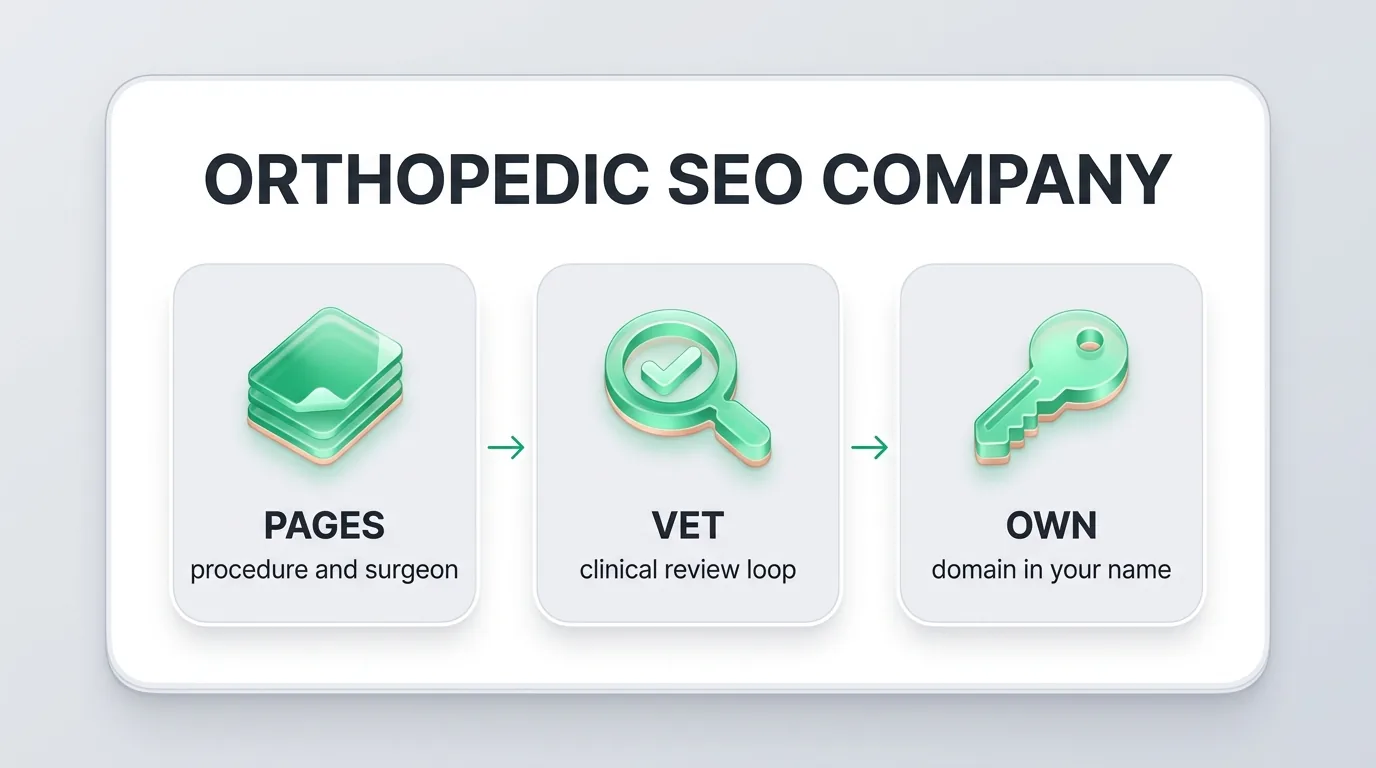
What you are really buying from an orthopedic SEO company
The work that moves surgeon and procedure pages
A patient with a torn rotator cuff opens three tabs on a Sunday evening: your shoulder page, a hospital service line, and a surgeon two towns over. She reads, closes two of them, books one consult.
Winning that comparison is what you pay an orthopedic SEO company for, and it gets won on two page types. One is a procedure page that says what recovery costs a working parent in weeks and restrictions. The other shows who will hold the instrument. Keyword research comes first in most orthopedic SEO services, then rankings start sending patients to a thin page.
Page-level craft for SEO for individual orthopedic surgeons goes deeper, though the retainer still lives on those two templates.
Who writes the clinical content, and who signs off on it
Ask who types the sentence about when patients drive again. Often a generalist writer fills it from a template, and the mistake reaches a patient before it reaches you.
A firm worth signing runs a review loop you can see: the writer drafts, a clinician on your side corrects, the firm publishes and logs what changed. That costs a short review pass per page, not an afternoon. It also keeps your outcome claims defensible, which is the part of healthcare compliance that actually bites in orthopedics. The trade-offs in choosing an orthopedic SEO agency mostly come down to who owns clinical accuracy.
What sits inside the retainer and what gets billed separately
The proposal says SEO, monthly. Eight months in you want a page for a robotic knee program, and it arrives as a separate line item with its own approval.
Pin the boundary down before you sign. Most retainers cover a fixed volume of content, technical fixes, reporting and a standing call. These usually land on top:
- a website rebuild or redesign
- photography and video days at your clinic
- ad budget and review software licenses
Scope drift is where practices overspend, so compare quotes against the full scope of an orthopedic engagement rather than the headline number.
How to vet a firm before you sign
Ask for orthopedic case studies with real patient numbers
A case study showing a keyword climbing into the top three tells you nothing about next Tuesday's schedule. Ask for consult requests by procedure line, how many became booked surgery, and over what period.
Then ask which practice the numbers belong to, and whether you may call them. A firm with real results gives you a name. Reviews of an orthopedic SEO company tell you about billing habits and responsiveness, not about whether anyone there has filled a spine clinic.
If you run an athletic line, ask for numbers there too. Sports medicine SEO competes against a different field.
Does it matter if they sit in your state?
Your patient never learns where your marketing firm sits. Practitioners still search for an orthopedic SEO company near California or near Texas, and the instinct is sound: you want someone who understands your market.
Proximity buys three real things: a shared working day, on-site days for photography, and a firm that already knows which hospital systems take your referrals. It buys nothing in the results themselves, where ranking depends on local SEO and map pack visibility handled properly.
Ask about competitive density instead. A firm that has fought for knee replacement in a metro market knows something a firm with only rural clients does not.
Confirm you keep the site, the profiles, and the data
A practice tries to change vendors and finds the domain registered to the old agency. That call happens more often than it should.
Years ago I spent a week prying my own clinic's Google profile back from a consultant who had made himself primary owner. His work had been decent. That week was not.
Check three things before the first invoice:
- the domain registered to your practice, with your card on the renewal
- your Google Business Profile owned by you, the agency added as manager
- analytics, Search Console and ad accounts in your name, with the firm as a user
Then ask what you still hold on day one if the relationship ends in a year. Everything, in writing.
What should change in the first twelve months
Reporting that ends at booked appointments, not clicks
A patient does not click. She calls at 4:40pm, or sends a form at 10pm, then either shows up or she does not.
Your report should end where her decision ends: calls long enough to be real, forms matched against the schedule, booked consults split by procedure. Ask which of those came from non-brand searches, since patients typing your practice name were already yours.
Dashboards of impressions and clicks are cheap to produce and easy to hide behind. A number that never touches your appointment book cannot tell you whether to renew.
When to expect movement, and when to walk
Movement arrives in an order. Non-brand procedure queries pick up impressions first, calls follow, and booked consults land last, which is why judging a firm on its first quarter punishes the ones doing durable work.
Walk when three things hold at once: nothing new has published in weeks, reporting still counts clicks after you asked twice, and no named person answers your email. Groups running several sites move slower again, since the multi-location side of clinic SEO spreads the same effort across more pages.
By twelve months you should be able to name the procedure lines that grew. If you cannot, the money went somewhere else.
Choose the firm that reports booked consults, leaves every asset in your name, and can show which procedure lines grew.