

Your coordinator writes the knee page Monday, chases reviews Tuesday, finishes nothing.
A single marketer can hold your pages steady, but orthopedic search needs a writer, a developer, and a tracker working at once. The math often tips toward a specialist team once one extra joint replacement case a month covers the cost.
Your marketing coordinator spends Monday rewriting the knee replacement page, Tuesday chasing reviews, Wednesday drafting the new surgeon's bio. Thursday the referral mailers go out. Nothing finishes.
One person covers breadth. Orthopedic search rewards depth: technical fixes, procedure pages, listings, and tracking that ties an evening phone call back to a signed surgical plan. An orthopedic SEO agency beats that setup because several people work several lanes in the same week. Your coordinator holds ground; they rarely take new ground, and a structured orthopedics SEO program is what closes the gap.
A good freelancer will out-write most agencies on a single hip arthroscopy page. Hire one for exactly that.
They stall on work that spans systems: schema across every condition page, a site migration, call tracking wired into your practice management software, listings for three offices that keep drifting. One person cannot be writer, developer, and analyst in the same week. Most SEO fundamentals for orthopedics are teachable. The coordination is what breaks. If your gap is a dozen pages and a cleanup, a freelancer costs you less and moves faster.
Run the numbers across a full year, not a month. A mid-level marketing hire costs salary, payroll tax, benefits, plus the tool stack: analytics, rank tracking, call tracking. Then add your own hours managing them. I made that hire once and spent my Friday afternoons briefing instead of operating.
A specialist retainer often lands in the same annual range with a team behind it. It wins when several workstreams have to move together, or when one service line pays for the whole spend: in most markets, one extra joint replacement case a month covers a serious budget.
The salary wins when you already rank and the work is upkeep: posts, reviews, small edits, listing hygiene. Paying specialist rates for maintenance empties the budget and fills nothing.
A patient with a torn meniscus searches from her couch and sees three names on a map. Which three depends on where she sits.
So one office and six offices need different work. A single location fights over one radius. A surgeon group fights on names as much as on procedures, because patients search the referral they were given. Multi-location groups mostly fight themselves: duplicate pages, a listing pointing at the wrong suite, one site cannibalizing the next, which is where local visibility for multi-location groups turns into its own project. A firm that has only run single-site work will treat your second location as a copy of the first.
Specialty depth shows up in vocabulary long before it shows up in case studies. A firm that has worked in orthopedics knows that someone searching "ACL tear recovery time" is a teenager hoping to play by spring, while "knee replacement surgeon near me" has been putting it off for two years. Those two pages need different evidence and a different next step. Sports medicine searches in your area behave nothing like spine or joint replacement demand. Have them outline your third-highest revenue procedure before you sign anything. A vague outline answers the question for you.
Three senior people sat in the pitch. Six weeks later your calls are with a coordinator who joined this year and carries nine accounts.
That swap costs you in the small moments: nobody chases the surgeon bios that have sat unwritten since spring, and how surgeon pages get found quietly stops being anyone's job. Get names, weekly hours, and the strategist's time written into the scope. Then ask how many accounts that person holds. A team stretched across dozens of clients hands you a template and calls it a plan.
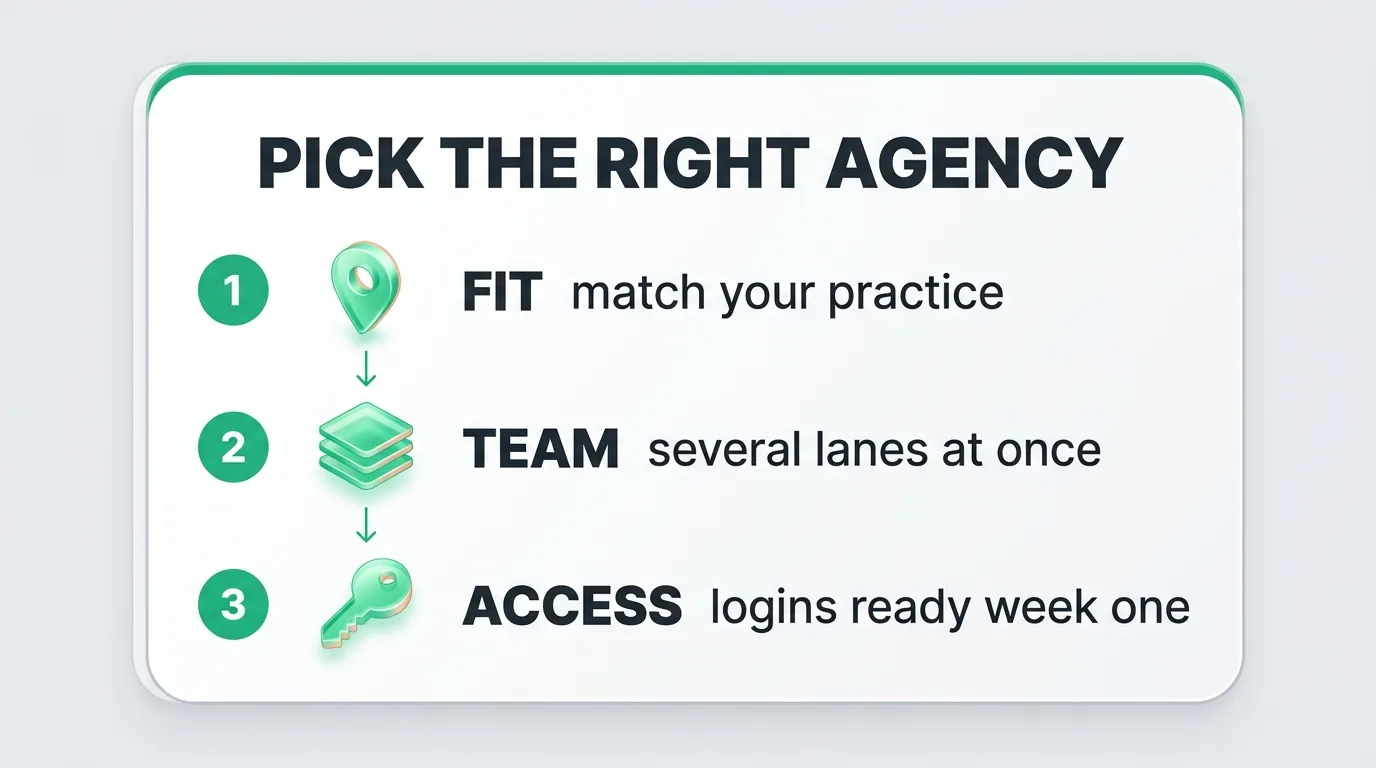
Most engagements stall in week two, and access is why. Nobody at the practice knows who owns the Google Business Profile, the listing that decides whether you appear when a patient searches on a Sunday evening, and the analytics login belongs to a developer who left two years ago.
Clear that before kickoff. What the work needs from you:
Skip the last two and orthopedic practice SEO services get aimed at traffic instead of at the cases you want to operate.
Budget a few hours of surgeon time a month, front-loaded. The first weeks cost more: one sitting to name the procedures you want more of, a short clinical read of the first drafts, and real photos of your theatre and your team. After that, a monthly call and quick sign-off carry it.
An orthopedic SEO agency that never asks for your time is writing from a template, and a patient weighing a lumbar fusion can feel the difference in two paragraphs. If you want the full set of questions to put to a firm, vetting an orthopedic SEO firm is a step of its own.
Decide by the work in front of you: breadth with several moving parts points to a firm, steady upkeep points to a hire.
We review your pages, search visibility and enquiry path, then show you what to fix first.