

He got patients found for knee surgery, then his own schedule couldn't fit them.
A clinic once got found for knee replacements faster than it could book them, so patients waited too long and left. The fix is matching what you promote to the room you actually have open this quarter.
✔ Look at which clinic sessions sit half empty before pushing any procedure.
✔ Pull every extra form and PDF off each page, leave just one phone number.
✔ Put the surgeon's name and the date checked on the page before it publishes.
A patient with a torn rotator cuff opens her phone at 10pm and types the name of her injury. She does not type the name of your practice. If your site answers her with one Services page listing fourteen procedures in a row, she reads none of them and leaves.
SEO for orthopedics works page by page. Rotator cuff repair gets its own page. Shoulder pain that has not been diagnosed yet gets a different one, because the person reading it has not decided anything. That separation carries the whole structure of orthopedics SEO services, since Google ranks pages, not practices.
Nobody types "degenerative joint disease of the medial compartment" into Google. They type knee pain when I go down stairs.
Lead each page with the words the patient used in your exam room, then bring in the clinical term right after it. Accuracy stays intact and the page becomes findable. One useful test: read your own page headings aloud and ask whether a patient could have said them. If athletes fill a good share of your clinic, the vocabulary shifts again, which is why sports medicine sub-specialty content deserves its own treatment.
Scroll to the bottom of your hip replacement page and count what waits there: a contact form, a phone number, a newsletter box, a PDF about insurance. That is four doors for one tired reader.
Pick one action per page and repeat it: request a consultation. Put it near the top for the patient who already decided, and again at the end for the one who read every word. A patient who lands from the map listing needs the same single door, something local visibility for an orthopedic practice depends on as much as your treatment pages do.
A page on ACL reconstruction written by a freelancer reads smoothly and gets two things wrong. A patient will not catch them. The referring physical therapist who sends you cases will.
Have the surgeon who performs the procedure read the page before it publishes, then put the reviewer's name and the date checked on the page itself. Google's guidance on health content asks for that visible expertise, and patients read it as proof a person stands behind the words. Deeper credential work belongs on individual surgeon profiles, so keep this page about the procedure.
By minute four of a consult, patients stop asking about technique. They ask when they can drive, when they can sit through a workday, when they can run again.
Answer that on the page, in your own ranges rather than borrowed averages, and say plainly what changes the timeline. A patient who read your recovery sequence before walking in arrives with expectations you do not have to rebuild from scratch. That conversation starts closer to a decision. Outcomes work the same way: what you track, and what you do when recovery stalls.
A primary care physician has your name on a sticky note and ninety seconds between patients. They open your site to check one thing: do you perform the procedure, and how soon can their patient be seen.
Most orthopedic sites answer neither. Give referrers a page that states what you treat, your typical time to first appointment, which plans you accept, and one direct line that reaches a human. Referral volume from primary care, therapy and urgent care never shows up in a ranking report, yet it fills a large share of your surgical schedule.
Years ago I pushed a practice I ran to rank for total knee replacement, because revenue per case looked best on paper. It worked. Then block time ran out, consults waited longer than patients would tolerate, and a good share went elsewhere before surgery.
So the first question in SEO for orthopedics is capacity, not margin. Look at where you have open block time, which clinic sessions sit half empty, which surgeon has room this quarter, then rank for those procedures first. Across several providers the arithmetic gets harder, which is where clinic level SEO scope earns attention.
A report showing traffic up and rankings up can sit beside a surgical calendar that has not moved. Rankings are a means. The booked consult is the result you pay for.
Tag the pages that produce form submissions and calls, then ask your front desk to note which page the patient mentions, and follow those cases through to a scheduled procedure. Most practices find a handful of pages carrying the work. Fund those. When you compare firms on reviews and claims, the honest filter is whether they report booked consults page by page, which is where choosing an orthopedic SEO partner starts.
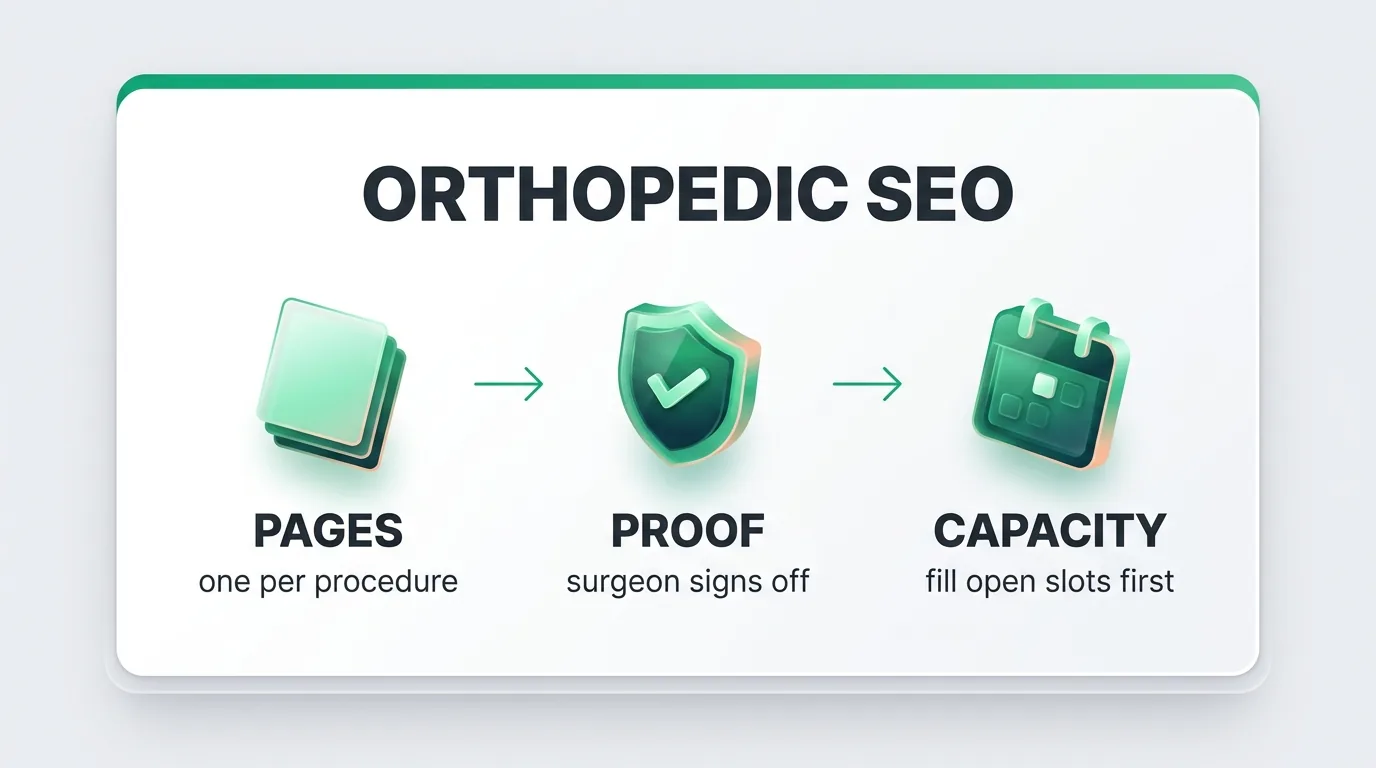
Build the procedure pages your schedule can actually absorb, have a surgeon check them, and measure which ones fill your calendar.
We review your pages, search visibility and enquiry path, then show you what to fix first.
.svg)