Build the map from your clinical service roster
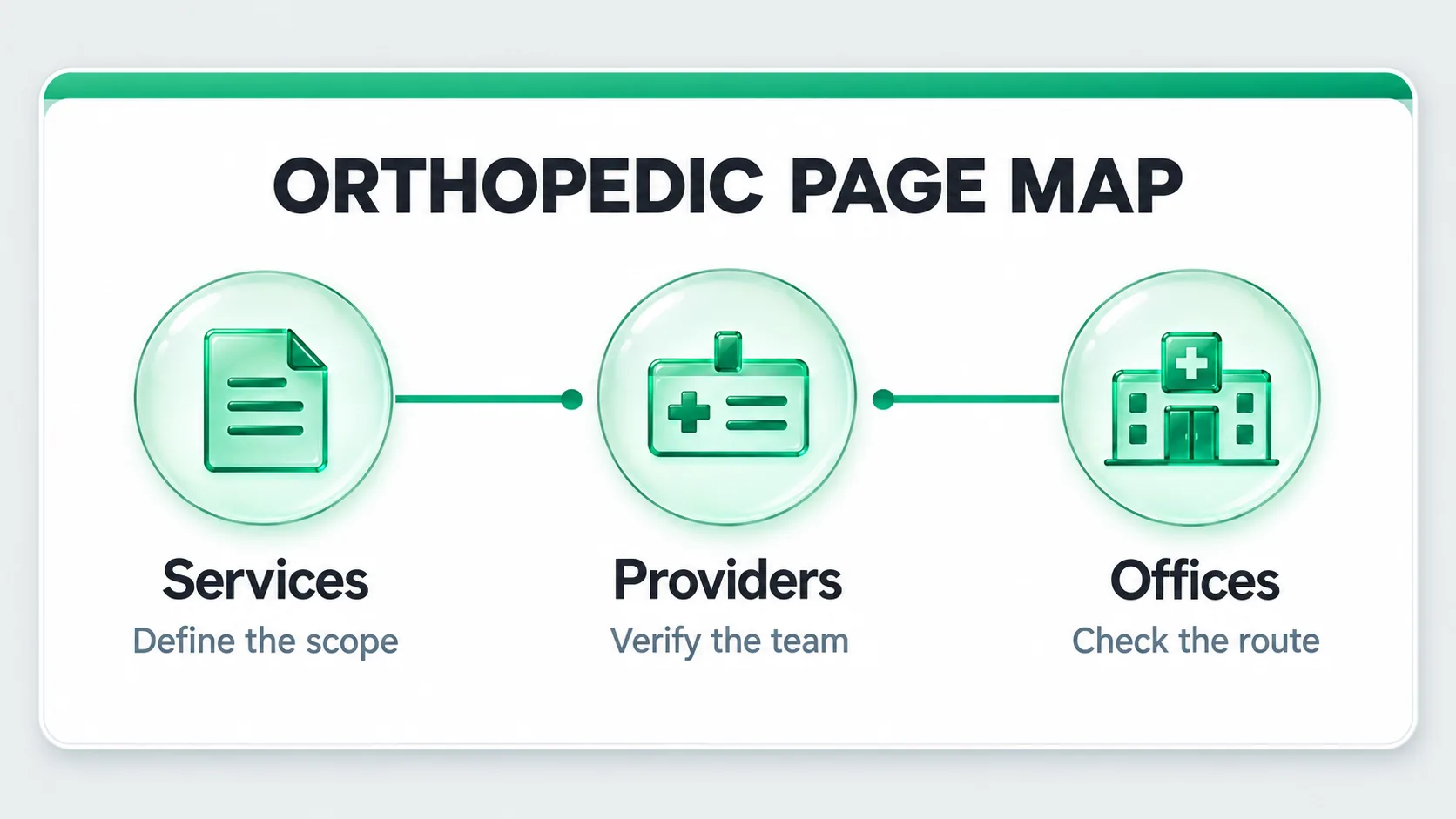
An orthopedic website needs to explain which team offers which service, where that team works and how someone reaches it. A list of body parts cannot answer all three questions. Start with a verified roster of services, clinicians and offices, then use search data to decide which gaps deserve attention.
The AAOS overview of orthopedic practice describes several subspecialties and notes that their scope can overlap. Your website should reflect the actual group. Do not assume that every surgeon treats every condition appearing in your keyword research.
Give the practice manager and a designated clinician one shared worksheet. For each service area, record its public name, responsible clinician, available office, existing URL and approved appointment route. Flag anything that cannot yet be confirmed. That row is a request for information, not permission to publish a new service.
Give each page a distinct job
Illustrative page map: this example describes an invented orthopedic group. It demonstrates website planning, not medical advice, measured search demand or the services of a Forge client.
Use the row that best matches the reader's task. A procedure page should not double as an entire service directory, and a biography should not contain copied versions of every condition article. The links connect the explanations; each page can stay focused. Sound healthcare web design keeps each page focused on a single reader task instead of merging several purposes.
Decide what to keep, improve or create
Export the current page list before proposing new URLs. For each page, write one sentence describing its purpose. Then compare that purpose with the queries reported for the URL in Search Console. A page can cover related wording without needing a second page for a reversed phrase or an alternative spelling.
For example, a group using both “orthopedic” and “orthopaedic” in its source documents does not automatically need duplicate service pages. Preserve the useful existing owner and use clear language in its content. A distinct location, clinician or referral task may justify another page when it provides information the owner cannot usefully contain. A group with several locations should review its orthopedic local SEO so each office page reaches nearby searchers.
Preserve the old content and URL relationships before a consolidation. A redirect is a release decision with consequences for existing visitors and links. It should have an appropriate successor, not merely a title that looks similar.
Connect the map with links that help the reader
Start with one service area. Its overview should lead to the actual clinicians and offices. Those biographies and offices should lead back to the service where relevant. A condition explainer can point to that overview without turning an educational passage into a promise that a particular procedure is suitable. A focused orthopedic referral page gives referring providers direct contacts for each service without duplicating clinical detail.
Use descriptive link text that identifies the destination. Google recommends crawlable links and useful anchor text. For the editorial team, a simple link register is enough: source, destination, anchor, reason and last checked date. Leave a planned destination out of the public route until it is available.
Hand the first service area to a reviewer
The review packet should contain the page map, one complete brief, the source documents and a list of decisions still needed. Ask the clinical reviewer to check service scope and medical descriptions. Ask the practice manager to check providers, office availability and the administrative route. Give both a named website owner who will implement accepted changes.
Before release, follow the route from overview to clinician to office on a phone. Check that the page titles, visible headings and contact labels agree. Record the final URLs and publication date. That record makes later search reporting interpretable and gives the next editor a map they can maintain.
For help prioritizing the work, see Forge's orthopedic marketing approach and request a free diagnostic with your website and priority service area.