Pair a consistent search view with the operational counts the practice can confirm and the work that was actually released.
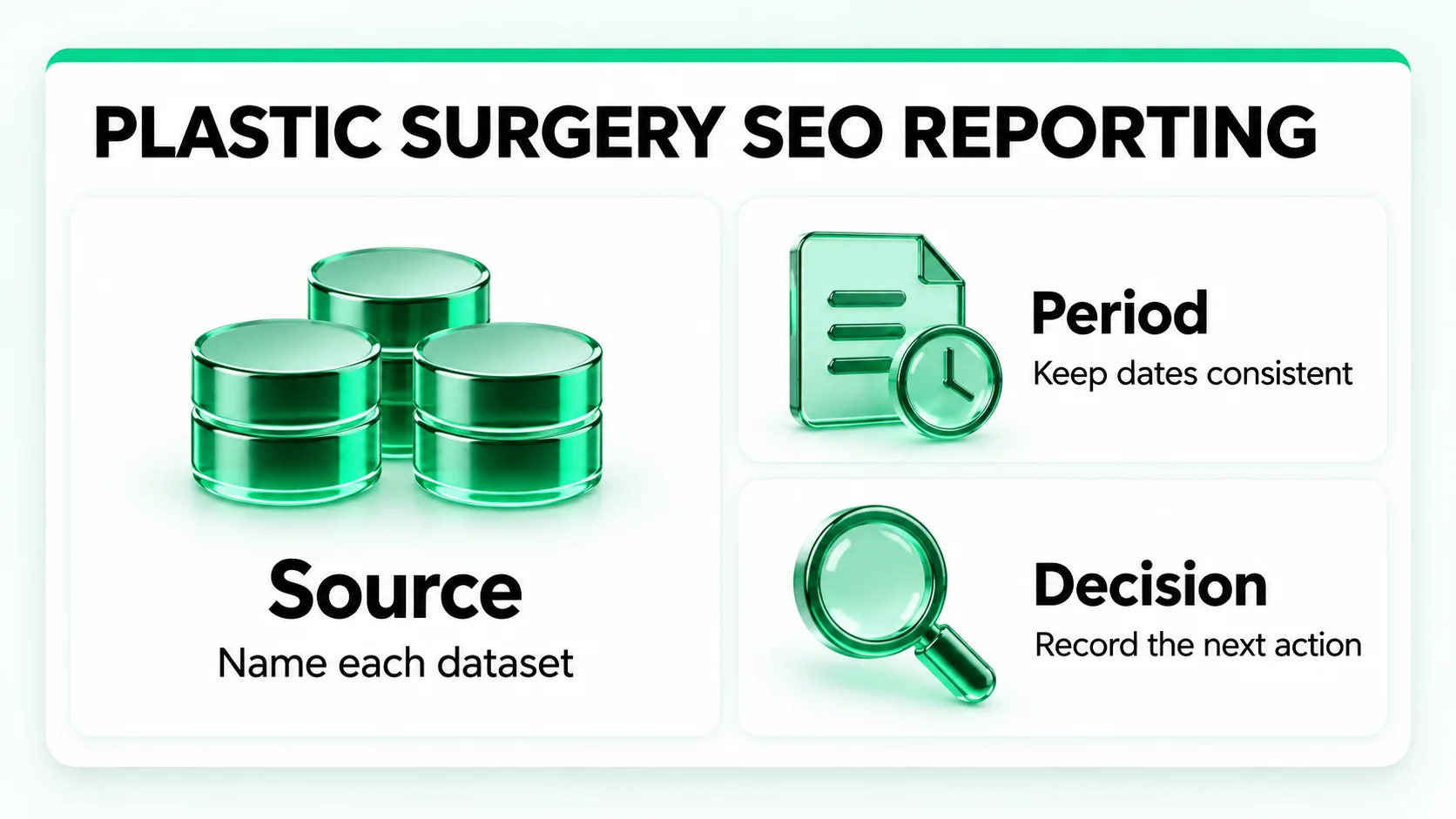
A plastic surgery SEO report should tell the owner what changed in search, what the website recorded and what the office can confirm. Those are separate observations. Putting them into one unlabeled “conversion” total makes the next decision harder.
Use this reporting structure to connect a procedure-page work log with a search summary and a reviewed inquiry count. It gives the marketing and office teams a shared vocabulary without turning every click into a consultation or every consultation into a scheduled procedure.
Agree on the reporting period, US country filter where relevant, search type and pages included. Keep the filters in the report so the next month can be compared on the same basis. Review the available 28-day and 90-day views together when the practice has enough history, and document any incomplete period.
Google Search Console reports search clicks, impressions, CTR and average position, with dimensions such as query, page, country and device. These describe search performance. They do not identify which people attended a consultation. Location-specific search patterns are central to local SEO for plastic surgeons.
| Report line | Source | Definition to agree |
|---|---|---|
| Search visibility | Search Console | Filtered clicks, impressions and CTR for the named page set and period. |
| Website request events | Approved website measurement setup | Successfully recorded requests, with test events and duplicate firing checked. |
| Reviewed inquiries | Practice's authorized operational records | Unique relevant requests after the office identifies spam, duplicates and unrelated contacts. |
| Consultations scheduled and attended | Appointment records | Separate statuses and a stated cohort or appointment-date basis. |
| Procedures scheduled or completed | Practice's operational records | Separate outcomes and dates, reviewed by the practice. |
| Revenue | Approved financial records | Collected revenue, refunds and timing; keep projections or quoted fees separate. |
Assign a person to each source. The agency can report the search data it can actually access. The practice owns confirmation of appointment, procedure and financial outcomes. If one of those sources is unavailable, show the gap instead of estimating the missing patients. Clear task ownership between agency and practice is a useful signal when comparing how to choose a healthcare marketing agency.
Illustrative example: every number in this section is invented to demonstrate the calculation. It is not a Forge client result or a target for a practice.
In a matched search view, a procedure-page group records 5,000 impressions and 100 clicks in one period, then 6,000 impressions and 108 clicks in the next. CTR changes from 2% to 1.8%. Clicks rose while CTR fell. Inspect the queries and devices before deciding whether the page title needs a change.
Separately, the office reviews a cohort of 12 incoming requests. It identifies two duplicates and three unrelated contacts, leaving seven relevant inquiries. By the review date, five of those seven have scheduled consultations and three have attended. The other statuses remain open. These numbers describe that cohort; they are not a search conversion rate.
The office has reliable source information for only four of the seven relevant inquiries. Report the remaining three as unknown. Do not distribute them across channels to make an attribution table add up to a preferred story.
A request received near month-end may become a consultation in a later month. Decide whether the operational table follows inquiries received in the reporting month or appointments occurring in that month. Both views can be useful, but they answer different questions.
For an inquiry cohort, preserve the original cohort and update its later statuses with an “as of” date. For an appointment activity report, use the appointment date and label it accordingly. Do not divide this month's attended consultations by this month's search clicks and call the result a conversion rate unless the population and attribution method genuinely support that calculation.
Record cancellations and rescheduling consistently. A rescheduled appointment is not necessarily another unique inquiry, and a procedure quotation is not collected revenue. Agree on these rules before comparing service lines or months.
Begin with the data the practice is authorized to use. A marketing report does not require names, clinical notes or patient photographs. Keep clinical and identifiable operational information within the practice's approved systems and share only the reporting outputs that have been authorized.
Google's Analytics guidance on personal information specifically covers risks in URLs, form input and custom dimensions. Inspect what the implementation actually sends rather than assuming that an event with a neutral name contains no sensitive data.
For US practices subject to HIPAA, Google's HIPAA and Analytics guidance states that Analytics does not offer a Business Associate Agreement and must not receive PHI. Have the practice's privacy and legal owners approve the proposed measurement scope and vendors. Renaming an event or removing an email field is not evidence of compliance.
Use the report to choose the next action. If a relevant page appears more often but the queries are poorly matched, review its purpose and links. If the approved form is failing, fix and test the form. If requests reach the office but statuses are missing, improve the operational record before interpreting conversion performance.
Attach the actual page changes and release dates so the team knows what was implemented during the period. The timing can help frame a review; it does not prove that one edit caused every movement in search.
Finish with four lines: observation, unresolved question, next action and owner. That makes the report useful even when the sample is small. For help defining this within a plastic surgery marketing program, request a free initial diagnostic.