

The firm sitting at number one on that list paid to be there.
Most lists naming the best orthopedic marketing experts are built on paid placements, not honest judging. The real test is one reference call about who fixed problems when something broke months later.
A writer who has never sat in an orthopedic clinic puts "knee surgery recovery" in your page title. Your patient typed "how long until I can drive after a partial knee replacement." Only one of those matches a person deciding whether to book.
The orthopedic SEO experts who last know that a unicompartmental knee and a total knee are different decisions, and that "spine specialist" covers two separate referral paths. Ask one to describe your sub-specialty mix in their own words before they explain how orthopedics SEO services fit together. Hesitation there tells you most of what you need.
A real specialist raises the rules before you do. Patient testimonials, before-and-after imagery, success rates, board certification wording: each one carries a limit set by your state board and the ad platforms, not by your marketer.
Watch who flinches. Mention a case photo and a generalist asks whether you have the file. Someone who has worked inside medicine asks how the consent was documented and whether the patient can still withdraw it. The same gap opens up in how a named surgeon gets found, where every claim sits on your license.
A shoulder replacement candidate reads for weeks. She visits your site four times, watches one video, compares two surgeons, asks her physical therapist, then calls. A playbook built for same-week service businesses reads those visits as a failure and pushes more traffic at it.
Depth fixes that, not volume: pages that answer the second and third question from someone already in pain and already comparing. Sub-specialty patterns split too, which is why sports medicine search behavior rarely matches a joint replacement line.
Search for the best orthopedic SEO experts and the top result is usually a list. Scroll to the footer. The firm at number one published it.
The rest of the ranking gets sold three ways: a sponsored slot on a directory, a referral fee on every lead the list sends, or an editorial trade for a link. Reviews of orthopedic SEO experts on those same platforms come mostly from clients the vendor chose to ask. None of that is dishonest, and none of it is evidence. Treat a roundup as a map of paid placement, build a shortlist, verify it yourself. Weighing an agency team against an internal hire comes later, and never from a list.
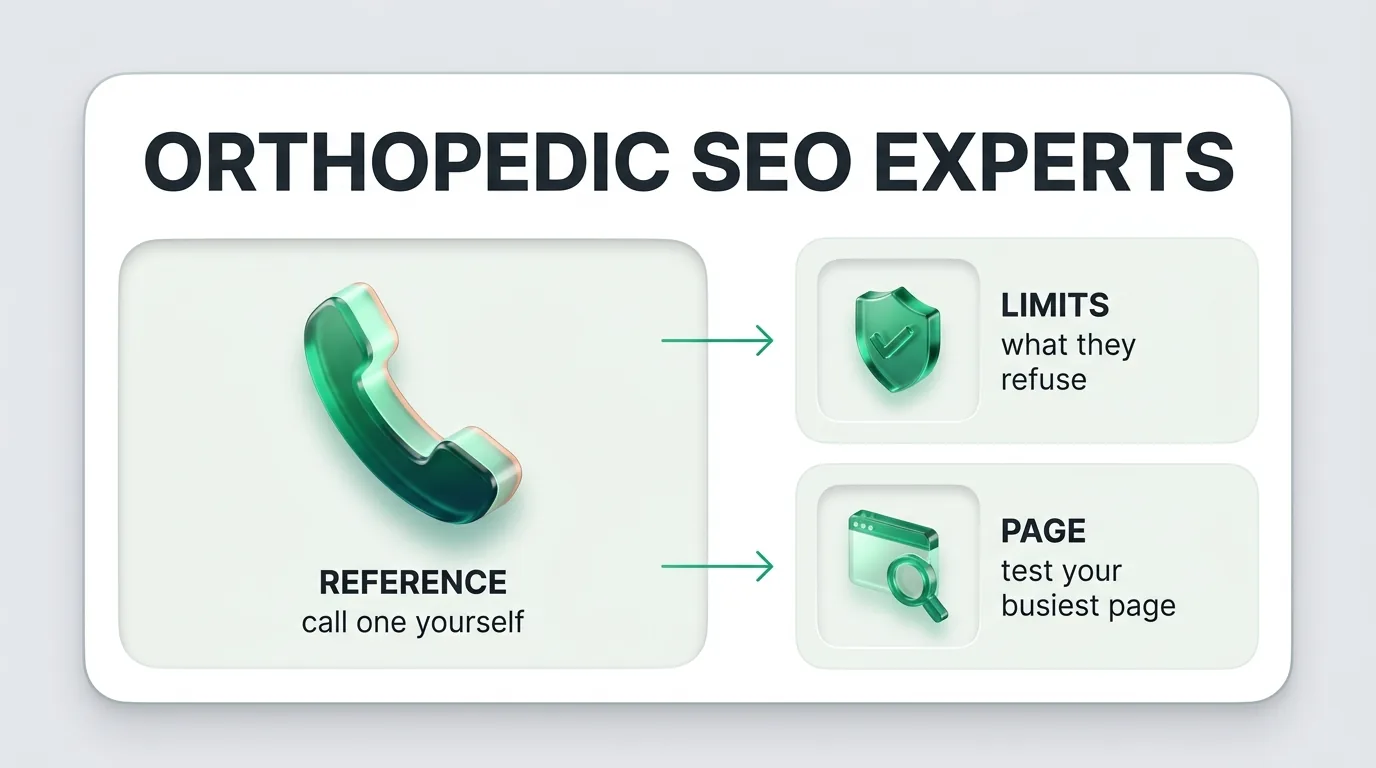
Ask for one reference you pick: a practice your size, same sub-specialty, at least a year in. Then ask that practitioner something no case study covers. Who replied when something broke in month seven?
When I ran my own clinic I hired on a polished deck and spent the next year forwarding my own emails back to the vendor. The reference call I skipped would have cost me twenty minutes. Ask also for a client whose results stalled and listen to how they describe it; vetting the company behind the person starts with whether they name that account at all.
Put your highest-volume procedure page on the screen during the call and stay quiet. A generalist names the missing heading, the thin word count, the slow image. All true, all cheap.
Someone with orthopedic depth asks what the page is meant to produce, and which question your front desk still fields after a patient has read it. Every edit then ties back to that answer. The structural work behind condition and procedure pages matters, though a diagnosis you can follow out loud matters more on a first call.
Every vendor will tell you what they can produce. Ask what they would decline, and the room changes.
The answers worth hearing: no "best surgeon in the city," no success rate without a published source, no promised recovery window, no patient story written for the patient, no clinical page going live before a surgeon reads it. A vendor who treats all five as negotiable writes checks against your license. The board letter arrives at your address, and the patient who followed a timeline your site invented sits in your room, holding copy that was approved in a meeting you never attended.
Share your Search Console and analytics on the call and ask them to read it back with no prepared slide. Most of your traffic today is people who already know your name. An expert separates that from new demand inside a minute, because only one of the two is work they can claim.
Listen for what they count: booked consultations and tracked calls, not positions. Ask which pages already convert, and where local map and search results sit against your organic pages. Someone who cannot read your numbers live will not move them in a report.
Pick the person who shows restraint and reads your numbers cold, then let the contract follow that judgment.
We review your pages, search visibility and enquiry path, then show you what to fix first.
.svg)