

A referral found your old doctor still listed online and booked somewhere else.
A parent researching braces and an adult asking about clear aligners want completely different answers from the same page. A referral can read your site, compare you to two nearby specialists, and decide before ever calling your front desk.
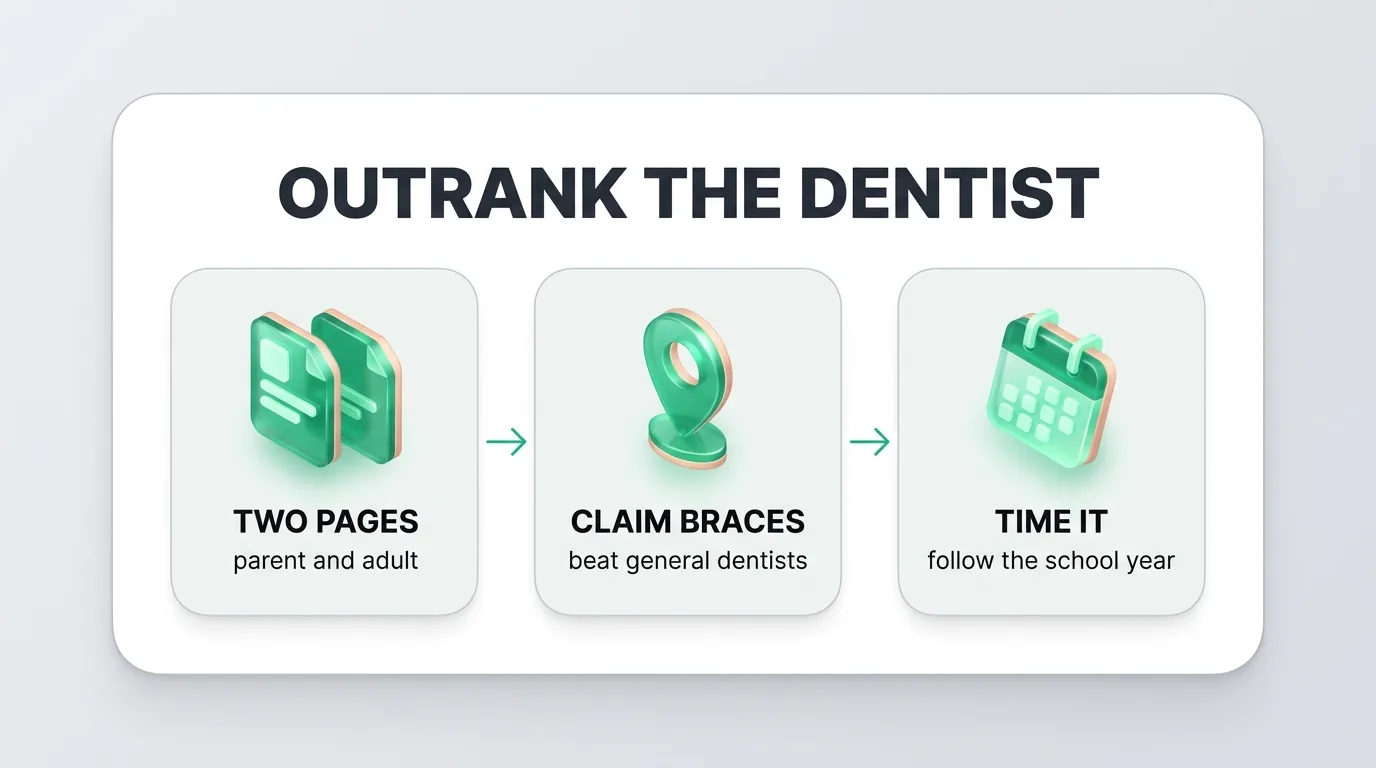
Two people search for the same treatment and want opposite answers. A mother types braces for kids near me on a Tuesday night, weighing whether her 11-year-old will tolerate two years with you. A 34-year-old project manager searches clear aligners at lunch and wants to know if anyone on a video call will notice. Orthodontist search engine optimization only works when each of them lands on a page written for one of them. Mix the two and you lose both.
Give the parent timing, school years and what the first visit covers. Give the adult discretion, treatment length and how payment gets handled. Nearly everything in orthodontic SEO services for a specialist practice follows from that split.
A parent researches braces in September, consults in November and starts in January. Nothing about that window is unusual, and it changes what your site has to hold. One service page cannot answer a question asked in September and a different one asked ten weeks later.
So the questions get their own answers: the age for a first evaluation, how long treatment runs, what happens at a consultation, how families spread payments. Each page catches someone at a different point and hands them forward.
Early in my career a referral we were proud of never booked. The parent found our site, saw a doctor listed who had left eighteen months earlier, and booked elsewhere. She never called to tell us.
A referral slip does not end the search; it starts a name check. The parent reads your site, compares you against the two specialists closer to home, and decides before the phone rings. That nearby comparison runs largely through local visibility for nearby ortho cases, which is where a referral either holds or disappears.
The general practice down the road ranks for braces because its site has carried hundreds of dental pages for a decade: cleanings, crowns, whitening, implants, and braces as one line among twenty. Google already reads that domain as the dental answer in town. Your single-specialty site is smaller by design.
You win elsewhere. Depth beats breadth on specialist questions: growth timing in children, extraction decisions, surgical cases, relapse after a first round of treatment. A GP page on braces runs two paragraphs. Yours can be the page a worried parent actually finishes.
Parents do not know what a residency is and will not look it up. Say it in their terms instead: you spent years after dental school doing nothing but moving teeth and jaws, you see cases like their child's every week, and you can tell them when waiting a year beats starting now.
Name your limits too. Telling a family which cases you would refuse to treat with aligners earns more belief than any adjective, and it gives the pages that turn searches into consults something a competitor cannot copy.
Yes, if you provide the system and have something to say that a general dentist cannot. A thin page carrying a brand name competes with the manufacturer's own locator and every GP in the county, and it loses.
Build one page per system you offer, not one per marketing variant. Use it for what the brand's site will never cover: the crowding and bite problems where you would choose fixed appliances instead, how often you check progress, what happens when a tray stops tracking. If running that call year after year sits outside what your team can carry, choosing an ortho SEO partner becomes the real decision.
Mid-June brings four consults in one afternoon, each parent asking the same thing: can it be on before school starts. Orthodontic starts bunch up. Summer break, the weeks after Christmas, and the January reset on insurance orthodontic benefits pull families in together.
FSA dollars expiring in December do the same at the other end of the year. The consult happens weeks before the start, and the searching happens weeks before the consult. Count backwards and the demand you want in July gets researched in April.
A page published in June for a June peak arrives late. New content takes time to mature in search. Timing is the part of orthodontist search engine optimization nobody puts on a calendar, and it decides whether the rest of the work pays.
So run it on one: adult aligner content through late winter, early-treatment and teen pages by early spring, benefit and payment pages in autumn before the December scramble. Get the site and link foundations for an ortho practice settled first, because a page published into a slow site waits twice. In 2026 that planning separates a year of work landing in a peak from landing just after it.
Pick the two pages your next peak depends on, write each one for a single searcher, and publish them early.
We review your pages, search visibility and enquiry path, then show you what to fix first.