Ask for named work items and evidence. Keep unknown answers visible instead of converting a sales promise into an assumed deliverable.
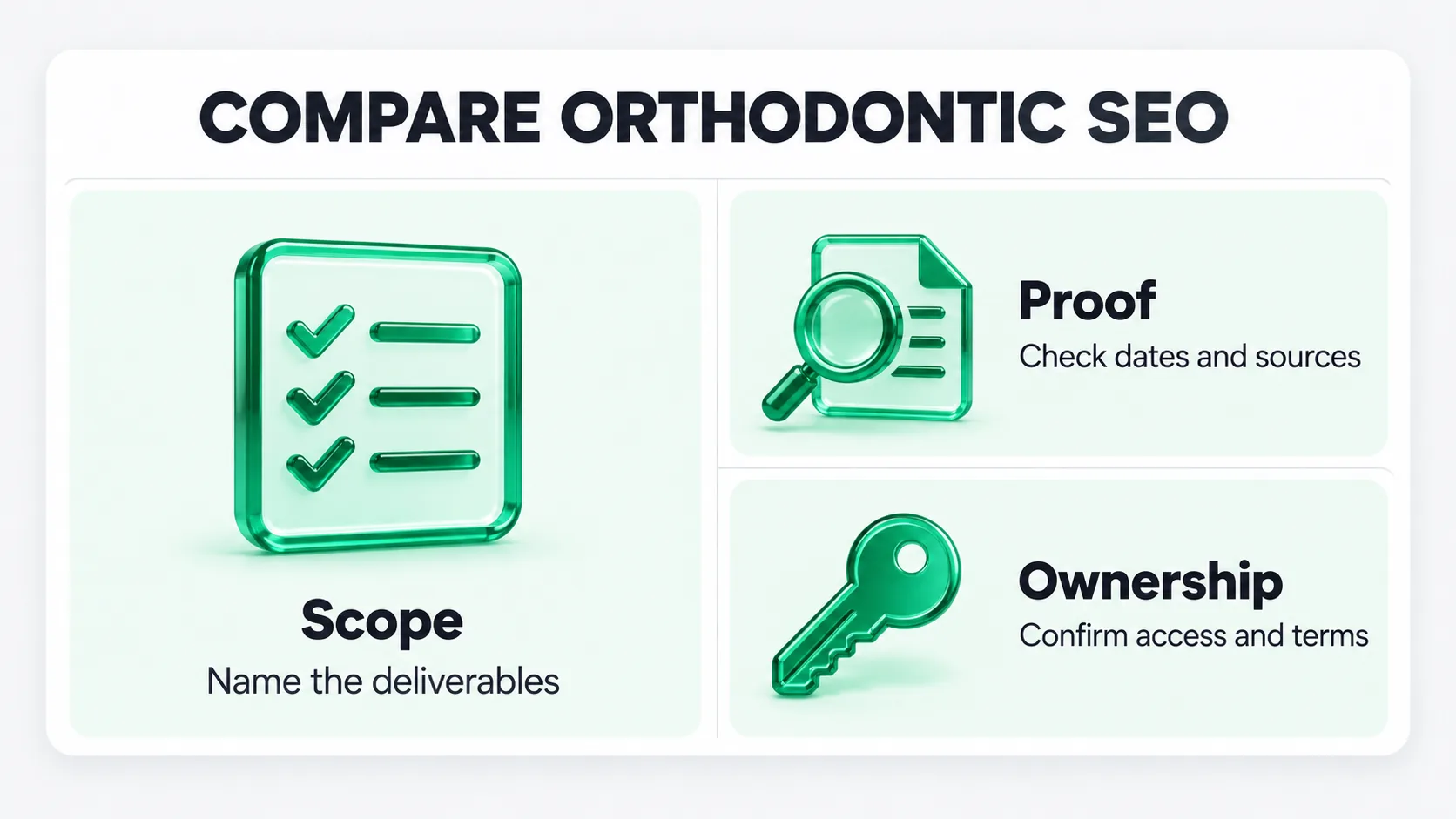
Choosing an orthodontic SEO company is easier when each proposal responds to the same practice brief. Start with the website, actual offices, current marketing responsibilities and the problem the team wants help solving. Examples include inconsistent location information, unfinished treatment pages or reporting that cannot distinguish search activity from inquiries.
Ask each provider to explain what it would inspect, what it would change and what the practice must supply. A proposal that lists services without naming deliverables leaves you comparing labels rather than work. “Content optimization” could mean editing a title or researching and rebuilding a complete page.
This checklist is written by Forge, which sells healthcare marketing services. It is a buying framework, not an independent ranking of agencies. Apply the same questions to Forge and any other provider you consider.
Prepare a short brief with the website URL, office URLs, current CMS, relevant account owners and the pages or routes that concern you. Include what you know and what remains unverified. Share access through an agreed process rather than sending passwords in the brief.
Describe the intended scope of the first work package. A practice could ask for an office-information audit and the revision of an existing first-visit page before agreeing to a broader content program. That is a scoping example, not a universal sequence or a fixed package price.
Google's guide to hiring an SEO recommends assessing experience, proposed methods, communication and realistic expectations. Use the provider's explanation to understand the work before granting implementation access.
Illustrative comparison worksheet: fill the final column with an actual proposal reference or a written answer. An unanswered question is “not provided,” rather than an automatic yes.
| Decision area | Question for the provider | Evidence to request | Record |
|---|---|---|---|
| Deliverables | What specific pages, profiles or reports will change? | Named work items and acceptance checks | Not provided |
| Implementation | Who makes CMS changes and checks the result? | Responsibilities, access and QA process | Not provided |
| Clinical review | Who approves treatment and provider statements? | Named practice reviewer and revision process | Not provided |
| Proof | What do the cited examples actually demonstrate? | Source, dates, market and metric definitions | Not provided |
| Reporting | How are search metrics separated from inquiries? | Sample report with sources and limitations | Not provided |
| Commercial terms | What is included, excluded and billed separately? | Currency, fees, scope and cancellation terms | Not provided |
| Ownership | What access and materials remain with the practice? | Account roles and handover terms | Not provided |
Use the table to request clarification. It is not a numerical quality score, and a larger document is not necessarily a better proposal. The goal is to make responsibilities and unresolved decisions visible.
A delivered website, a search-visibility change and an increase in attended consultations are different types of evidence. Ask which one a case study actually supports. Check the market, dates, starting position, work performed and measurement source.
For a chart, ask whether the figures are first-party observations or a third-party estimate. For a consultation claim, ask how inquiries, scheduled appointments and attended visits were defined and connected to the work. If those records are unavailable, keep the outcome unverified.
Relevant healthcare experience can still be useful when it comes from another specialty or country. It should be described accurately. A dental project in France is not proof that the same result has been achieved for a US orthodontic practice.
You can apply this standard to Forge's documented projects and case studies. Ask about the underlying scope and evidence for any example used in a proposal.
Ask to see one page brief and the route from draft to approval. The brief should identify the intended reader, the task, the owner URL, the facts to verify and the responsible reviewer. Clinical descriptions should remain subject to the practice's approval.
Clarify whether content is written, edited and implemented within the quoted scope. Ask how old claims, FAQs, image captions and metadata will be checked when a page changes. A new body paragraph does not correct an outdated promise still displayed elsewhere on the same page.
Discuss account ownership before onboarding. Name the owner of the domain, CMS, Search Console and Business Profiles, and define the access needed by the provider. Include backup, change-log and handover arrangements in the proposal. Do not accept a verbal assurance as a substitute for the terms you need in writing.
A provider can commit to an agreed deliverable and review date. Search rankings and treatment starts depend on more than that delivery. Ask what an expected result is based on, how uncertainty is described and what happens if the evidence does not support the initial assumption.
Google's hiring guidance warns against guaranteed first-place rankings. Also question a promised number of treatment starts when the proposal does not explain the practice's operational measurement and attribution. A calendar deadline for finishing an audit is different from a guarantee that consultations will rise by that date.
For the first reporting review, ask for a short decision log: what changed, what the data shows, what remains uncertain and what the team proposes next. This makes a report useful even when it cannot yet support a business outcome.
Before signing, confirm the deliverables, reviewer, implementation owner, costs, exclusions and next checkpoint. Put any city or specialty exclusivity in the written scope, with its actual territory and exceptions. Avoid treating a broad sales phrase as a defined contract term.
If you are considering Forge, review our orthodontic marketing scope and request a free initial diagnostic. Bring the same worksheet and questions you would use with another provider.
We review your pages, search visibility and enquiry path, then show you what to fix first.
.svg)