What SEO for orthodontists changes in your consult flow
Why organic visibility matters when referrals slow down
A referring dentist two suburbs over sells the practice, and the new owners keep aligner cases in house. Nothing changes in your schedule that month. Six months later the Tuesday column has holes in it, and nobody can point to the week it started.
SEO for orthodontists answers a question referrals never posed: what happens when a parent chooses you without anyone pointing the way. They search braces or clear aligners in your city on a Tuesday night, open three sites, and book one consult. That choice is mostly made before your phone rings, and everything orthodontic SEO as a service does aims at that half hour.
Where online-found patients fit next to your referral base
Organic search will not replace your referring dentists; it reaches the cases they never send.
The self-referred adult is the clearest example: mid-thirties, no general dentist raising the subject, quietly bothered by crowding they have noticed in every photo for a decade. That person starts on a search bar. So does the family that moved into your catchment in June. None of them come through your network, and most compare two or three practices, so local search visibility around your practice decides who makes the shortlist.
Your referral base stays the floor. Organic sits on top of it and sends people who already read your treatment pages, which shortens the consult.
What a realistic first year looks like
You publish four treatment pages in January, check the numbers in February, and find almost nothing has moved. That is the normal shape of it. A site needs months before Google trusts it on competitive treatment terms, and early work shows up late.
The year runs in three parts: building and fixing the pages that matter, then the first consult requests from search landing, then a stretch spent working out which treatment page converts and why. If you want that sequencing mapped page by page, the full plan behind orthodontic search sets it out.
Build the few pages that turn interest into a booked consult
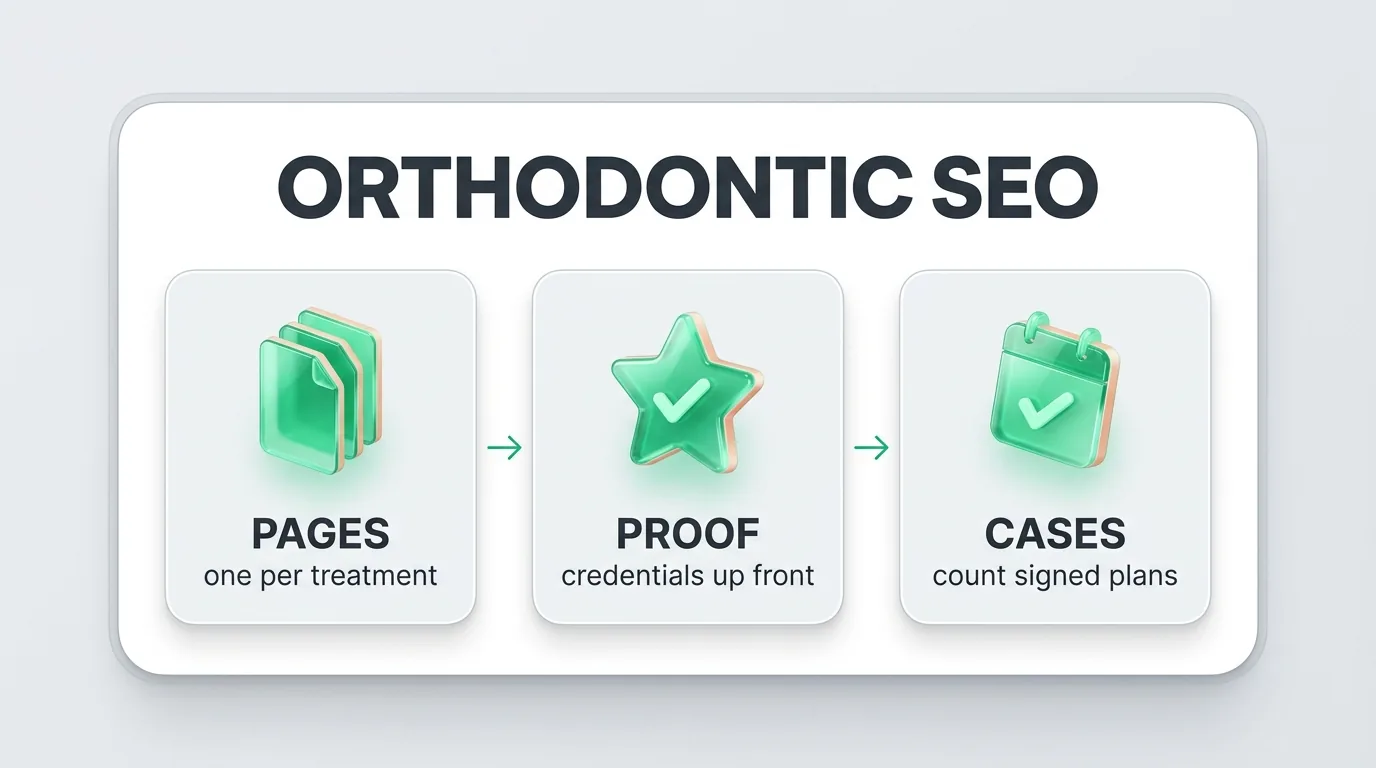
Give aligners, braces and early treatment their own page
A parent researching early treatment for a seven-year-old and a thirty-eight-year-old comparing clear aligners to ceramic braces want almost nothing in common. One services page cannot hold both without losing both.
Give aligners, braces and early treatment a page each, and write every one to finish a decision: who the treatment suits, how long it runs, what the fee range covers, what happens at the first visit. Deciding how much of that you write yourself and how much you hand over is the practical question behind what an SEO service scope includes.
Show the specialist credentials a parent is checking
Your doctor page gets read more often than most orthodontists expect, usually in the ten minutes before someone calls. Parents check two things there: that a specialist will treat their child, and where you trained.
Name the residency, the board status, the years in practice and the professional memberships in plain language, next to a photograph that looks like the person they will meet. The gap between a specialist and a general dentist offering aligners deserves more room than one line, and specialist versus general dentist positioning covers it.
Answer the mail-order aligner question head on
A patient opens the consult by turning a phone toward me with a mail-order aligner price on the screen. I used to spend the first ten minutes of that appointment defending a fee instead of explaining a bite. The page they read the night before should have done that work.
So answer it on your aligner page: what supervised treatment includes that a posted kit does not (records, radiographs, attachments, bite correction, retention), which malocclusions need in-person mechanics, and where a kit genuinely suits a simple case. Honesty converts better here. Patients who read that and still book have already priced the difference, and they arrive to discuss their teeth rather than your fee.
Judge the work by started cases, not clicks
Track consult requests through to signed plans
Three numbers decide whether the work pays: consult requests from organic, consults that show up, and treatment plans started. Rankings and sessions tell you nothing you can bank.
Tag your inquiry forms and phone calls by source, ask at the consult how they found you, and match that list against starts once a month. A handful of organic consults that mostly sign beats a crowd that mostly browses. Judge SEO for orthodontists by the plans it can be traced to, not by the traffic graph your reporting tool opens with.
When to change course instead of adding more pages
Two quarters in, your braces page sits on the first results page and the consult requests still come from the aligner page. Six more pages will not fix that. The braces page has a conversion problem: no fee range, no clear next step, a booking form three taps deep.
Rewrite before you expand, and add pages only when a treatment you want more of has none. If a full year passes with no movement and nobody can show you which pages produced starts, the problem sits with the provider, which is when choosing an orthodontist SEO agency becomes the live decision.
Build the handful of pages your best cases actually read, then judge the work by the plans they start.