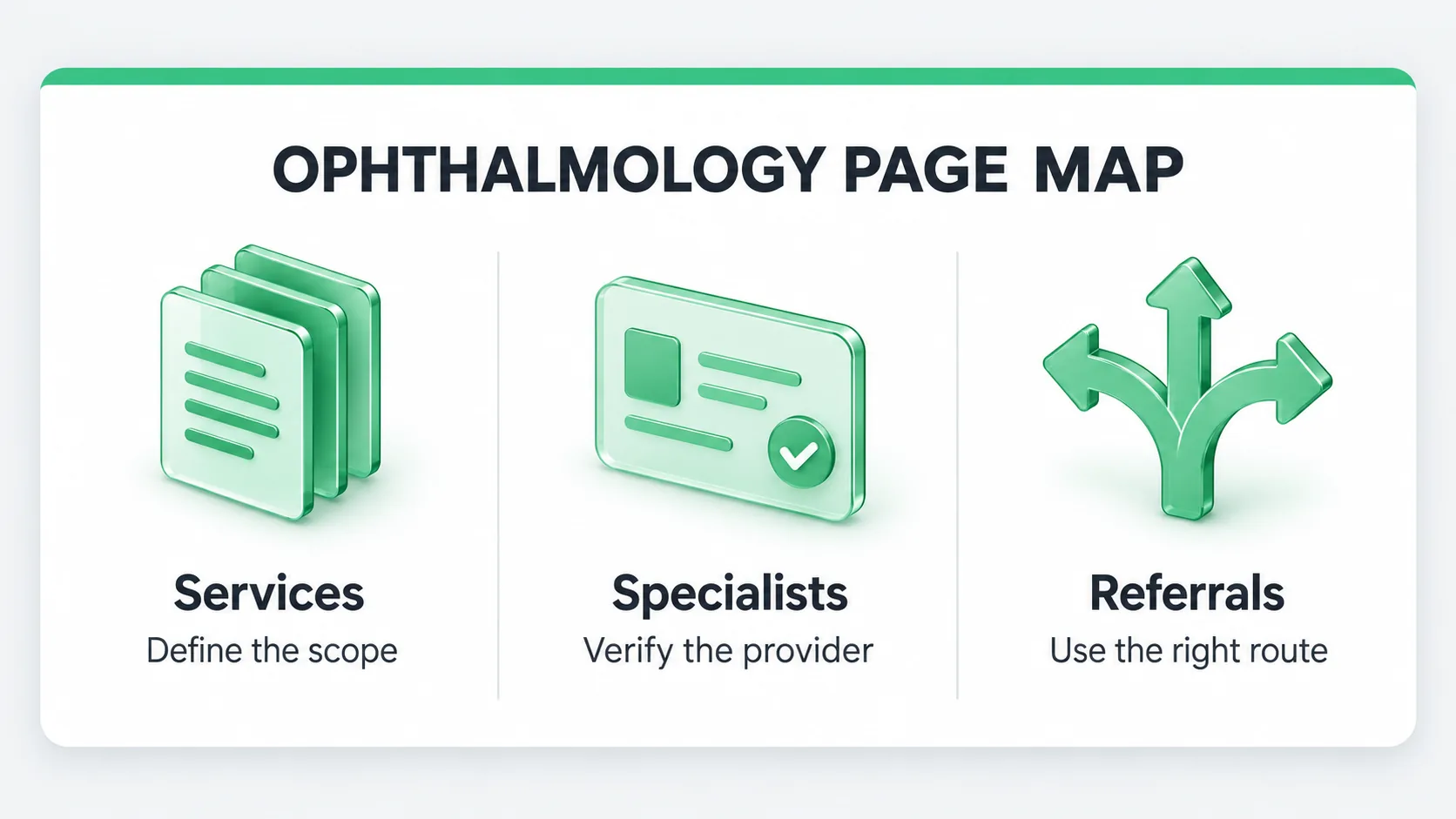
Map the practice before mapping keywords
An ophthalmology website can serve a prospective patient, an existing patient and a referring professional. Those visitors may use similar clinical terms while needing different information. Start with the services, clinicians and locations the organization actually operates, then decide which page should help each visitor take the next appropriate step.
Build the map with a practice manager and a clinical reviewer. Record the providers attached to each service, where they see patients and whether the public route is an appointment request, a referral process or an existing-patient contact. Do not assume that every clinician offers every service at every office.
Provider biographies should accurately identify qualifications and expertise. The American Academy of Ophthalmology’s position on truthful advertising emphasizes clear communication about provider training and qualifications. For the website team, the practical task is to verify the credentials and service descriptions that appear on each page, rather than imply a qualification from a generic “eye doctor” label.
Assign one main task to each page type
The following page map is an illustrative planning example. It is not a client’s site, a researched list of local search volumes or a recommendation for a patient’s care.
A term does not automatically justify a separate page. If two drafts answer the same question for the same audience, first consider improving the existing owner. A distinct page is useful when the task, content or next step is materially different. This prevents a website plan from turning into dozens of near-identical pages.
Build a service-page brief the clinician can review
Choose one actual service and complete the brief below before drafting its page. An editor can prepare the structure and patient questions. The clinical reviewer supplies or verifies the medical explanation and decides which limitations belong in the text.
- Owner and URL: identify the existing page if there is one. Keep a reason for creating a new URL.
- Audience: state whether the primary reader is a prospective patient, an existing patient or a referring professional.
- Service boundary: list what the practice offers and what the page must not imply.
- Providers and offices: verify the people and places attached to the service.
- Questions to answer: collect actual administrative questions and clinician-approved educational questions.
- Sources and reviewer: record the supporting documents, responsible reviewer and review date.
- Contact route: use the established process, including separate arrangements for existing patients or professional referrals where needed.
For example, a procedure page and a condition explainer need not have the same heading sequence. The explainer can provide context and direct readers to the relevant practice information. The service page should make the practice’s scope and access route clear. Neither needs a promised success rate, a universal recovery timeline or an invented patient story to be useful.
Google’s people-first content guidance encourages useful, reliable content and clarity about who created it. Apply that as a review standard. Adding an author name does not compensate for an unsupported medical statement, and a long article is not automatically a better answer.
Make referrals a distinct website task
A referring office needs a clear process rather than a patient-facing sales pitch. Ask the team that receives referrals what information can be described publicly and where the actual referral must be sent. Publish the approved administrative route, its responsible team and the way to confirm receipt.
Keep the public page separate from the transmission of clinical information. Do not ask referring teams to paste a patient history into an ordinary marketing inquiry form. Link to the organization’s approved secure system or describe its established alternative. The correct mechanism depends on the practice’s operational and privacy requirements.
Illustrative content brief: a “For referring professionals” page could identify the services accepting referrals, administrative prerequisites confirmed by the team, the approved submission destination and the contact for process questions. It should not promise acceptance, scheduling speed or treatment availability that the practice has not verified.
Connect services, providers and locations
Review each important service page as a small route through the site. Can a reader identify the relevant clinician, find the office and reach the correct next step without returning to the main menu? Add links where the relationship is useful and true. Thoughtful healthcare web design keeps these navigation routes clear for every visitor type.
A provider biography can link to the services that clinician actually supports. A location page can link to the services available at that office. A condition explainer can link to the relevant service when the practice provides it. Use descriptive link text and ordinary crawlable links, in line with Google’s link guidance.
Keep an internal link register with source URL, destination, anchor and reason. Test each destination before publication. A planned page should stay out of the public link path until it exists. This is especially useful when content is produced in batches by different people or systems.
Review the network as a working system
Use a short acceptance review for the first service area. Check that its overview, supporting education, biographies, location information and contact routes agree. Test the pages on mobile and desktop. Confirm that the headings describe the content, source links work and the intended clinician has reviewed the medical passages.
Then save a dated search baseline and a list of the URLs changed. Follow visibility and inquiries as separate measures. Publication demonstrates delivery; it does not demonstrate an improvement in referrals, attended consultations or revenue. If those outcomes are reported later, they need records from the practice’s approved operational systems.
Forge’s eye care SEO service can organize this work into a scoped plan. The eye care marketing page describes the broader specialty route. Request a free diagnostic to review the current site, its intended audiences and the first service area to improve.