

Save the source and settings for each number. Use explicit inquiry definitions, mark missing attribution and finish the report with a specific action supported by the evidence.
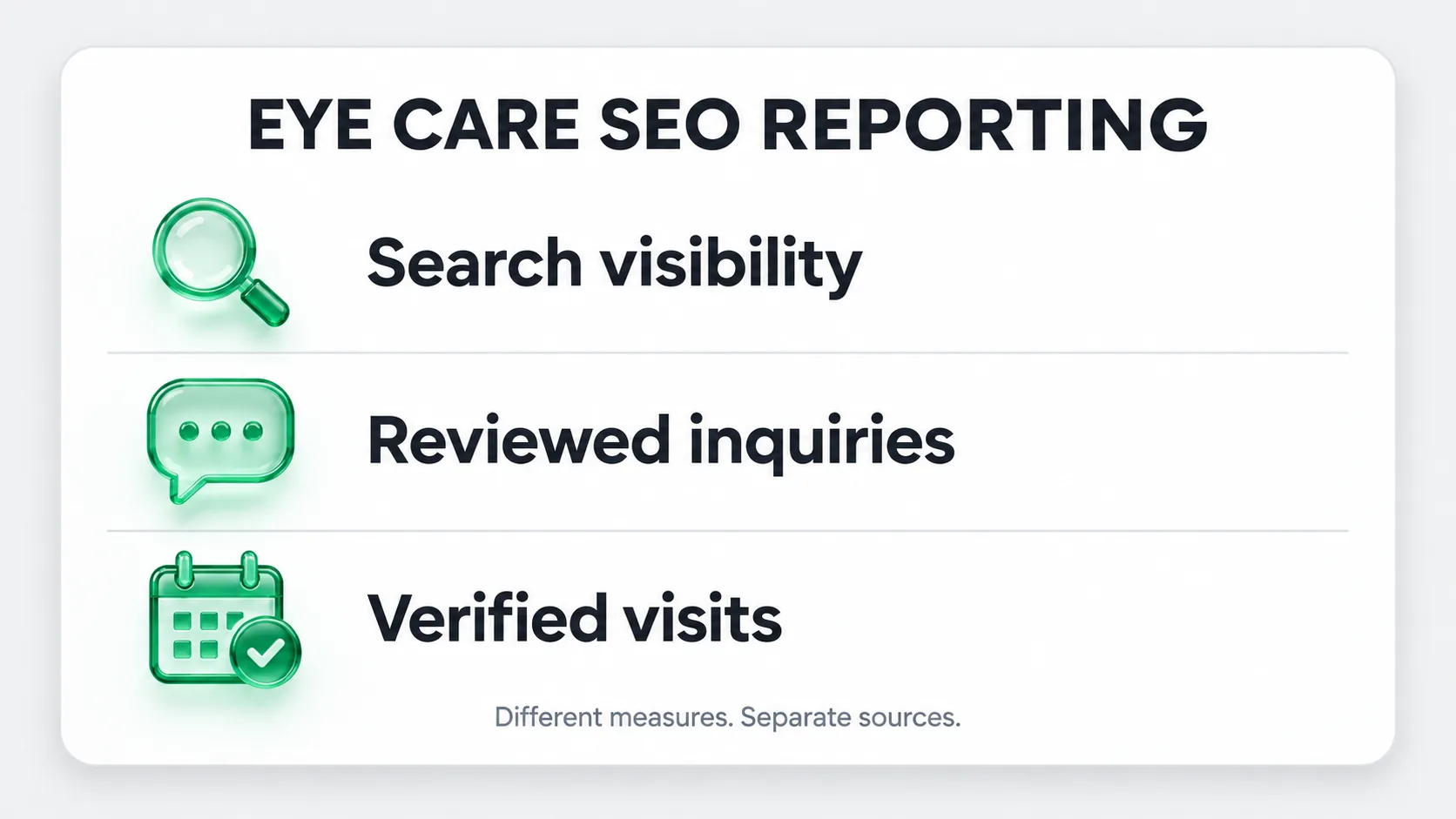
An eye care SEO report should distinguish search visibility, website contact actions and appointment outcomes. These measures answer different questions and usually come from different systems. Give every number a definition, a date range and an owner before combining it with another number.
| Measure | What it can show | What it does not establish |
|---|---|---|
| Search Console impressions | The reported appearances of your site in Google Search | People treated or even website visits |
| Search Console clicks | Reported clicks from Google Search | A unique patient or a completed appointment |
| Profile call clicks | Clicks on the call button in a Business Profile | An answered call or an appointment request |
| Valid new inquiry | A contact reviewed against the practice’s definition | A confirmed booking |
| Scheduled appointment | An appointment entered in the approved scheduling system | An attended visit |
| Attended visit | An attendance status recorded by the practice | Revenue, profitability or proof that SEO caused the visit |
Google documents how Search Console counts impressions, clicks and position. Average position summarizes reported appearances; it is not a guarantee that every person in the city sees the same rank. Google’s Business Profile performance guidance defines call counts as call-button clicks. Keep that label when the only evidence comes from the profile report.
Record the property, search type, country, device filters and exact start and end dates. Use the same settings when you compare periods. For a US practice, a country filter can isolate US searches, but it does not identify the searcher’s state, city or language.
Review the latest complete 28-day window for operational changes and a 90-day window for context. Compare each with a period of equal length when making a change calculation. Do not compare 28 days with 90 days and describe the difference as growth. If a site change happened inside either window, put its date next to the result.
Google’s filtering and comparison documentation explains how page, country and device filters interact. Save the configuration with the export so a colleague can reproduce the view. For seasonal appointment patterns, also consider a comparable prior-year period when enough history is available.
Keep page totals and query analysis separate. Search Console omits some queries for privacy and does not show every row. Its dimensions guidance describes these limits. A missing query row is not proof of zero demand, and a query-filtered total need not equal the unfiltered page total.
Illustrative example: every value below is invented to demonstrate the reporting method. This is not a Forge client result or a benchmark. The two search periods contain 28 complete days and use the same filters.
| Search measure | Previous 28 days | Current 28 days | Safe interpretation |
|---|---|---|---|
| Impressions for a selected page group | 4,000 | 4,200 | 200 more recorded appearances in this view |
| Clicks for the same page group | 60 | 63 | Three more recorded clicks |
| CTR | 1.5% | 1.5% | Clicks divided by impressions is unchanged |
The current-period operational worksheet might separately show six contact records, four valid new inquiries after review, three scheduled appointments and two attended visits. Those counts describe different stages. They should not be added together as fifteen leads.
If the practice has not established a reliable, permitted connection between those records and organic search, label their source “unattributed.” Do not divide the two attended visits by 63 clicks and present the result as an SEO conversion rate. The records may describe different populations, repeat contacts or appointments first requested in an earlier period.
Turn the report into a short decision log. Describe the observation, the uncertainty, the next check and the person responsible. A change in one metric rarely identifies the cause by itself.
| Observation | Check before drawing a conclusion | Possible next action |
|---|---|---|
| Impressions rise while CTR falls | Has the query mix broadened? Did device mix or average position change? | Review relevant queries and page messaging before rewriting the title |
| Clicks rise but reviewed inquiries do not | Are the periods and attribution comparable? Does the approved contact route work? | Test the route and review the new search audience |
| Inquiries rise but scheduled appointments do not | Are contacts valid, within scope and handled by the intended team? | Review the administrative handoff and capacity with the practice manager |
| A page has no visible query rows | Check page status, filters, available dates and reporting limits | Investigate the page instead of assuming the service has no demand |
For a multi-location practice, keep the office distinction only where the source supports it. A page about one office is not proof that every inquiry belongs to that location. Ask the operational owner how office choice is actually recorded. A dedicated local search plan for optometry practices can clarify how office choice should be recorded across locations.
The report should use the minimum information needed for the business question. Clinical records, appointment details and patient identifiers belong in the systems approved for that purpose. A marketing worksheet can work with reviewed aggregate counts and explicitly stated limitations.
Do not send names, email addresses, symptoms, diagnoses, referral text or appointment notes to a general analytics tool. Review URLs and event parameters as well as form fields. Removing an obvious name does not establish that a tracking configuration is appropriate for healthcare use.
Google states that Google Analytics does not offer Business Associate Agreements and must not receive protected health information from HIPAA-regulated entities. Have the practice’s responsible privacy or legal team determine whether a proposed measurement configuration is appropriate. This worksheet does not certify a platform or implementation.
Finish the report with an action that the evidence supports. For example: “The examination page’s appointment link failed on mobile. The website owner will repair it, verify the confirmation route and record the release date.” That is an actionable finding even before any change in search clicks is observed. Reliable healthcare web design reduces the chance of appointment links failing on mobile devices.
Keep delivery and outcomes on separate lines. “Three service pages reviewed and published” is a delivery record. “Organic clicks increased” is a search observation. “Two attended appointments attributed to organic search” requires an appropriate operational record and a stated attribution method. None should silently stand in for the others.
Forge’s eye care SEO services include defining the reporting scope within the agreed engagement. For a broader discussion of search and other channels, see eye care marketing. You can request a free diagnostic with your website, market and current priorities.
We review your pages, search visibility and enquiry path, then show you what to fix first.