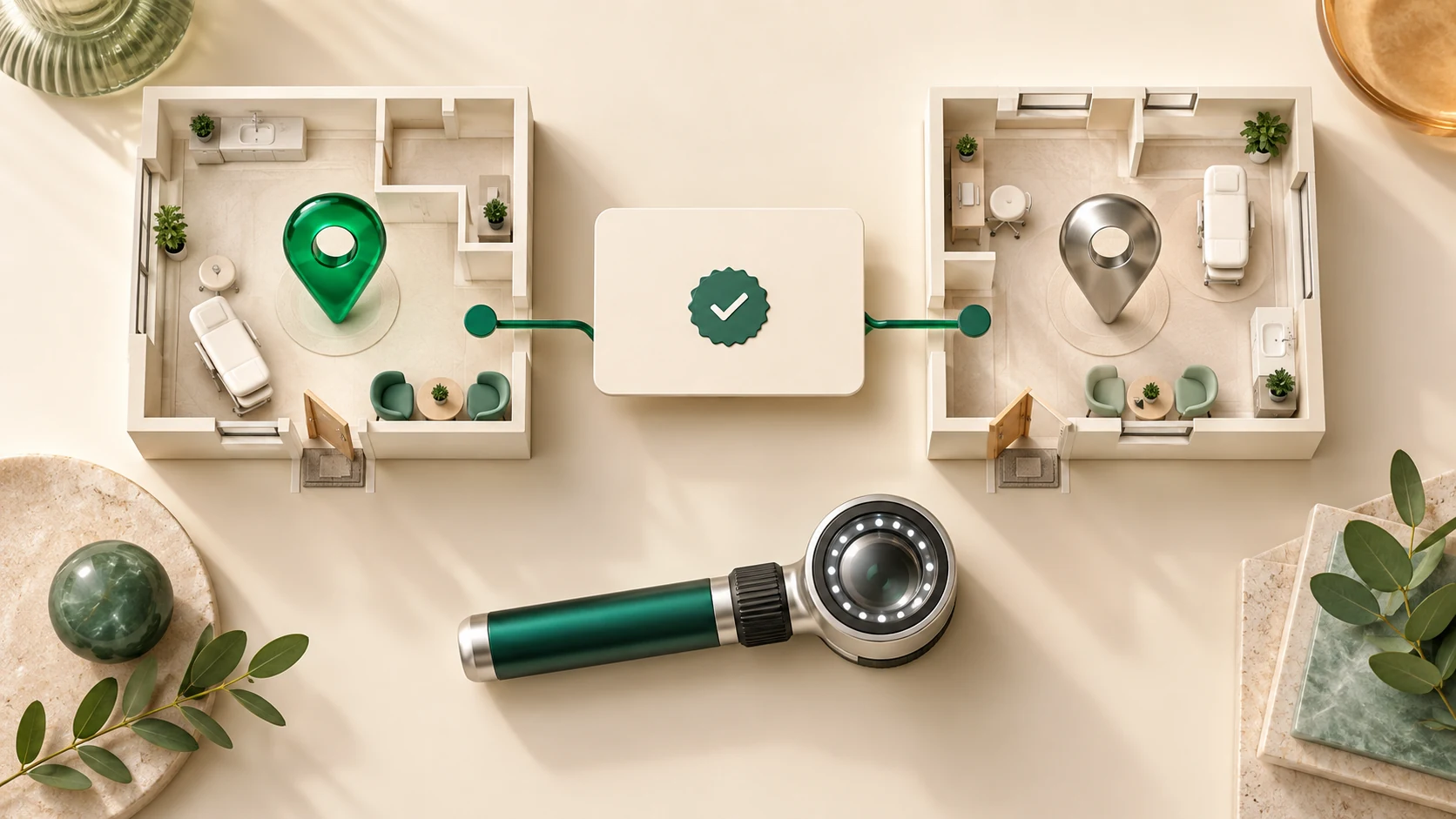

She searched for a mole check nearby and your office never came up.
Google shows up the office closest to her phone, not the best one in town. She also checks how recent your last review is and whether your insurance list answers her first question.
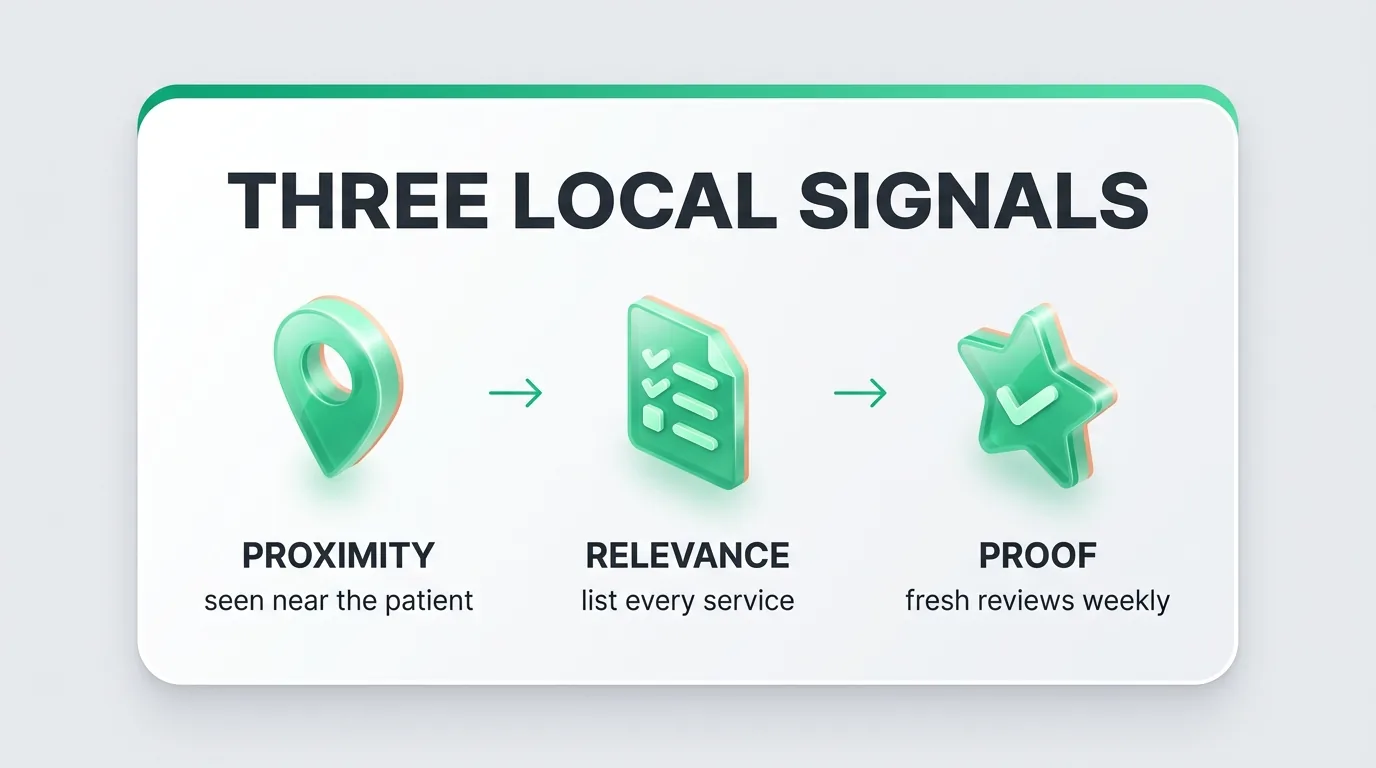
A woman notices a mole changing shape. She opens Maps on a Saturday morning, searches for a dermatologist, scans three listings and books the second one. Your office sat four miles away and never appeared. Local SEO for dermatologists runs on proximity first: Google ranks the map pack against the spot the patient is standing in, not against your city. That radius is tighter than most practices assume, closer to a handful of neighbourhoods than a metro area. Which is why your visibility map matters more than your ranking report. Check what surfaces from the postcodes your patients actually drive in from.
Proximity gets you seen. Relevance decides what you get seen for. Google reads the services on your listing and the pages behind them, then matches them against the words the patient typed. A practice listing only dermatology surfaces for generic searches and loses the specific ones: Mohs surgery, psoriasis care, laser resurfacing. Those searches carry the intent and the value. Write out the procedures you want more of, in the words patients use, and drop the ones you no longer perform.
A practice owner showed me his review page last spring, proud of the wall of five stars. The newest one was two years old. Reviews age, and Google weighs recency alongside volume, exactly as the patient does when she compares you to the clinic collecting a few every week.
Proof also lives off your own site. A matching listing on Healthgrades, Zocdoc and Bing, a mention from the hospital you refer into, a sponsored community screening day: each one confirms you practise where you say you do, and it compounds with the wider dermatology SEO groundwork behind your website.
Your primary category decides which searches your listing can enter at all. For a dermatology practice the real decision sits between Dermatologist and the cosmetic labels: Skin Care Clinic, Medical Spa, Cosmetic Surgeon.
Choose by caseload, not by ambition. If medical work pays the lease, Dermatologist goes in as primary, and the cosmetic labels follow as secondary categories where they still pull injectable and laser searches. Flip that order and you quietly vanish from skin cancer screening searches, the ones with the shortest path from a phone to a booked appointment. Skip the broad labels like Doctor or Medical Clinic, which throw you in against every practice in town.
A patient scrolling your listing at 9pm hunts for one word, and it is hers: eczema, rosacea, Mohs. The services section holds far more entries than most practices bother to fill, and every one you add gives Google another phrase to match you against. Go granular. Instead of cosmetic dermatology as a single line, name the treatments one by one and push the procedures you want more of to the top. Each listed service needs a real page behind it on your site, or the entry ranks thin.
The booking link belongs on the profile itself, not two clicks deep in your site. Point it at the page that holds the appointment type she came for, so a Saturday search ends in a Monday slot rather than a callback request. Photos carry the rest: the entrance, the waiting room, a treatment room, the physicians. Before and after images need written marketing consent, and a consent form signed for treatment does not cover publication. No faces, no identifying marks, no patient dates buried in the file names.
Two offices, one contact page listing both addresses. That setup ranks for neither. Location pages are where local SEO for dermatologists lands on your own site, so give each office its own: the address exactly as Google holds it, the local number rather than a central line, an embedded map, parking and the nearest landmark, hours, and the physicians who actually work that site. Name, address and phone have to match character for character across your site, your profile and the directories. A suite number written one way here and another way there splits the signal and costs you the map pack.
Your front desk makes this call several times a day: the patient asks whether you take her plan, hears no, and hangs up. Every one of those is a slot you could have given to a patient who fits.
Name the plans you accept on the profile and on every office page, in a list she can scan before she dials. Say what happens for out of network patients, and whether a referral is needed for a surgical consult. Dermatology turns on that split, with medical visits running through insurance while cosmetic work stays self-pay. Spelling it out converts calls into appointments and keeps the ones that were never going to book off your phone.
Fix the category, the services, the photos and the office pages, and the patient who finds you arrives already leaning toward treatment.
We review your pages, search visibility and enquiry path, then show you what to fix first.
.svg)