Use a verified roster and eight checks to turn conflicting location information into owned corrections.
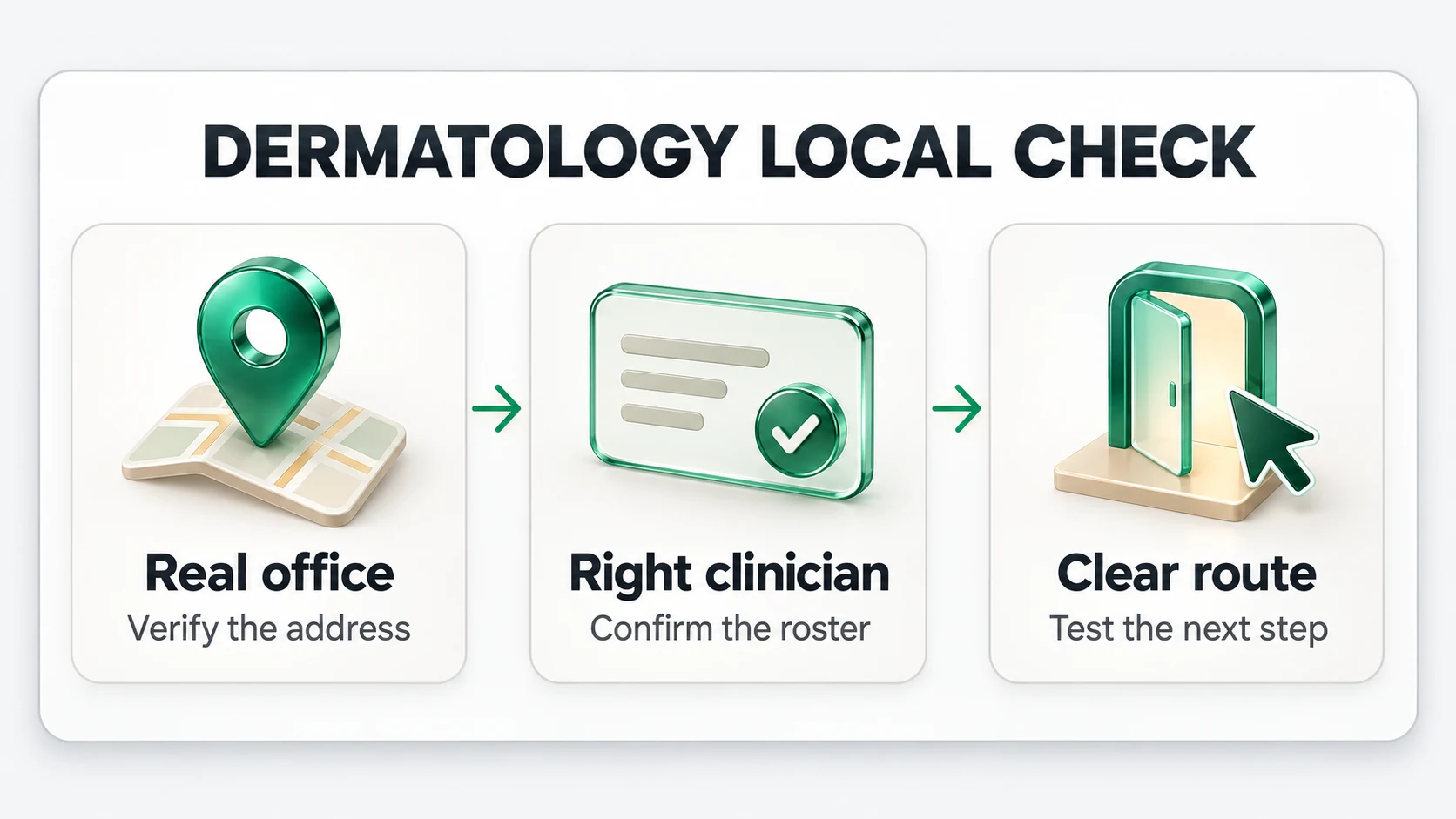
Dermatology local SEO starts with a reliable connection between the practice, each real office and the clinicians working there. A correct address is not enough if the service page, physician biography and appointment link point to different locations.
Use the audit below to check one office at a time. It produces a short correction list with evidence, an owner and a test, so the practice manager can review changes before profiles or pages are edited. A specialized dermatology marketing agency can run this audit process for practices without in-house marketing staff.
For each office, record the public business name, full address, main phone, current hours, clinicians, confirmed services and approved appointment destination. Assign a practice owner to verify those details. Then compare the roster with the website and business listings.
Record differences before changing them. A listing may describe a former office, an independently practicing clinician or a legitimate separate department. Similar names alone do not prove duplication.
| Entity | Confirmed relationship | Website responsibility | Review needed |
|---|---|---|---|
| Example Dermatology, Central office | Real patient-facing office in this hypothetical practice. | Location page with its own hours, services and access route. | Practice manager verifies the underlying details. |
| Example Dermatology, North office | A second real office in the example; service mix may differ. | Separate location page with only services provided there. | Do not copy Central's availability without confirmation. |
| Dr A, dermatologist | Works at Central and North in the example. | One biography linking to confirmed offices and services. | Assess any practitioner profiles against Google's rules. |
| Cosmetic consultation service | Provided at Central only in the example. | Service page with a Central consultation route. | A service label alone does not establish a separate eligible business. |
Google's Business Profile guidelines distinguish organizations and individual practitioners. A practitioner needs a public-facing role and must be directly contactable at the verified location during stated hours. Multiple specializations do not justify multiple profiles for the same practitioner.
Review the current rules for the exact situation, including solo practitioners, several practitioners at one location and departments. A virtual office address does not establish an eligible patient-facing office. Do not create “medical dermatology” and “cosmetic dermatology” listings simply because they are separate keyword groups.
Use the real-world business name. Put service detail in the appropriate fields and website content; do not append a string of cities or treatment keywords to the name.
This is a working template, not a score claiming that every practice needs the same changes. Mark each line verified, needs correction or needs evidence.
| Check | Evidence to retain | Acceptance test |
|---|---|---|
| Entity and eligibility | Business or practitioner identity, ownership and applicable profile rule. | The profile represents an eligible real entity. |
| Name and address | Practice-approved details and observed website/listing values. | People can identify and reach the correct office. |
| Hours | Current operating hours and named person responsible for changes. | Profile and location page agree with actual availability. |
| Clinician relationship | Roster and current biography links. | The page lists clinicians who actually work at that office. |
| Service availability | Approved location-by-service list. | Cosmetic and medical services are attributed accurately. |
| Appointment access | Link destination, office context and dated test. | The next step preserves the intended location or lets the visitor choose it clearly. |
| Important directories | Observed entry, account owner and proposed correction. | Material business facts match the approved roster. |
| Change verification | Before/after record, reviewer and unresolved exceptions. | The public result reflects the approved change. |
Add columns for office, affected URL or profile, issue, proposed correction, owner and due date. If a value cannot be confirmed, keep it as “needs evidence” rather than filling the gap with a plausible address or phone number.
In the fictitious practice above, the North office page includes a cosmetic consultation button that opens Central's scheduling route without explaining the switch. The issue is the visitor's path, not just the anchor text. Keeping medical and cosmetic service pages separate prevents this kind of routing confusion for visitors.
A test that reaches the expected scheduling page proves the route works at that point. It does not prove an appointment was booked or attended.
Google describes local ranking through relevance, distance and prominence. This means a search from one neighborhood is not a citywide result. If you use map-grid observations, record the query, search points, date and provider, and compare the same setup over time. Google's local ranking guidance explains why location matters.
Prioritize incorrect facts and broken routes before interpreting small rank changes. Keep profile interaction measures separate from appointment records, and avoid asking review responders to confirm that someone is a patient. Tracking search and appointment access separately keeps ranking data from being confused with real bookings.
Take the eight checks through one location, resolve the material issues and use the verified roster to review the next. A consistent process is more useful than a list of unowned corrections across many directories.
Request your free diagnostic with Forge. Share the website, office locations and the local issue you want to resolve. From €1,200 per month, with no minimum-term commitment; scope, fees and terms are confirmed in writing.