Dr Juri Tassinari is a plastic surgeon working in Bologna and other Italian cities. The September 2026 diagnostic documented article rendering failures and errors on the www domain variant. This case explains the findings and proposed recovery checks. Recovery results have not yet been verified.
The diagnostic checks on September 2 and 3 found that 93 of 126 articles displayed raw page-builder shortcodes after the redesign. The finding concerns the rendering of existing articles, not a count of articles repaired.
The September diagnostic assigns 334 estimated monthly organic visits to the affected article URLs. This is Semrush's estimate for those URLs, not a count of people confirmed to have encountered the problem.
The diagnostic documented an access failure on the www variant and identified domain handling as a recovery priority. A proposed redirect or server correction still needs implementation and fresh validation before it can be reported as delivered.
The September diagnostic assigns 485 estimated monthly organic visits to the www variant. Together with the 334 assigned to affected articles, these separate URL groups total 819, or approximately 27.8% of the domain's 2,946 estimated monthly organic visits.
Crawler rules: document the robots configuration and citation observations separately. A blocked crawler alone does not prove why an assistant did or did not cite the practice.
Page experience: test relevant templates and devices, then date the results. A historical performance score is not a current measurement.
Local listing: the project journal records that Eugenia corrected the Bologna listing's website button during the August 20 call. This action by the client team does not establish a complete website recovery.
The archived August 6, 2026 article capture shows page-builder code in the rendered page. The September checks documented 93 affected articles. The capture is historical evidence, not a live status check today.
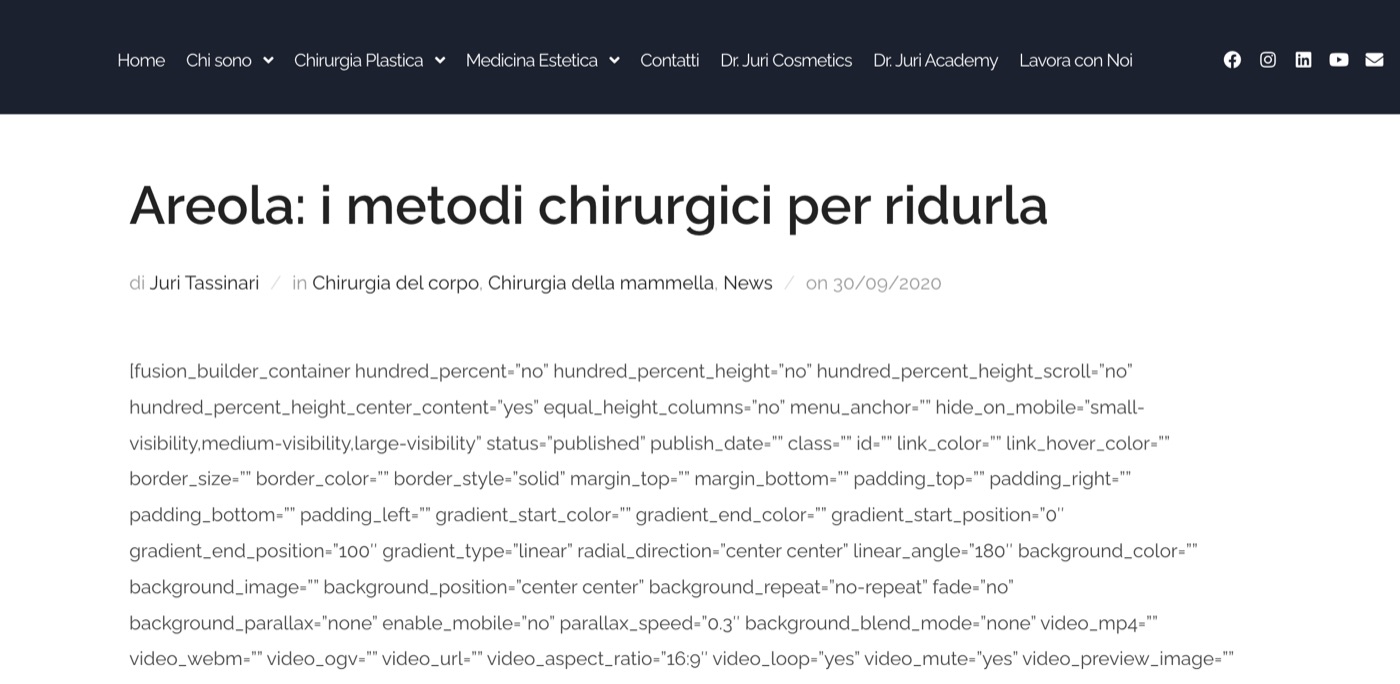
A recovery check should confirm that the article content renders, the URL returns the intended status, domain variants resolve correctly and the canonical points to the intended page. Those checks are acceptance criteria, not completed work reported by this case.
First document implementation and test the affected URLs. Then establish dated first-party search and conversion baselines and compare consistent periods. The project record reviewed here does not verify a recovery delivery, a confirmed start date or a search and revenue result.
The September diagnostic records 93 affected articles out of 126. This states what the audit found, not how many articles have subsequently been restored.
The 819 figure adds separate URL groups from the same September diagnostic: 485 for the www variant and 334 for affected articles. It does not measure patients lost or traffic recovered.
This case records a technical diagnosis and recovery plan. Implementation and recovery outcomes will require a separate, dated record.
The September checks found 93 of 126 articles displaying raw builder code, alongside an access failure on the www domain variant. The case documents these findings and the recovery checks required.
The September diagnostic assigns 819 estimated monthly organic visits to affected URLs, about 27.8% of the site's Semrush estimate of 2,946. This is estimated URL-level exposure, not measured lost visits, appointments or revenue.
The robots configuration and citation observations should be recorded separately. The evidence here does not establish that a single crawler rule caused an absence of citations or that patients never encounter the practice through assistants.
Explore Forge's medical SEO and technical website reviews or discuss the scope of your own project in a free initial diagnostic.
Tell us your specialty, your market and the services you want to grow. We review your website and current search visibility, then agree the scope and measurement plan before work starts.
.svg)