Build dental backlinks that help local authority
Start with citations, associations, and partner mentions
Your Google Business Profile sits at the center of local visibility, but the links surrounding it determine whether Google trusts the site behind it. Before any outreach campaign, the foundational layer deserves attention: your name, address, and phone number consistent across Healthgrades, Zocdoc, WebMD, the ADA directory, and your state dental association listing. These are not glamorous. They are the baseline that makes everything else work.
Partner mentions follow the same logic. A referring orthodontist, a pediatrician who sends families your way, a dental lab that lists preferred practices: each of those pages carries local relevance that a generic directory cannot replicate. Solid dental marketing strategy treats these relationships as link assets, not just referral courtesy.
Earn a few local editorial links before chasing volume
A community health column in a local paper, a quote in a regional parenting site about children's first dental visits, a sponsor mention from the youth football club you support: these editorial links carry weight precisely because they are earned, not requested via a template. One or two per quarter, placed on a page that already ranks locally, moves the dial more than fifty directory listings on sites Google ignores.
The effort is modest. Reach out to a local health editor when a relevant study drops, or sponsor an event that already generates press coverage. For practices building this from scratch, the broader process of link building for dentists covers the outreach mechanics in more depth.
Match each link source to the services you want found
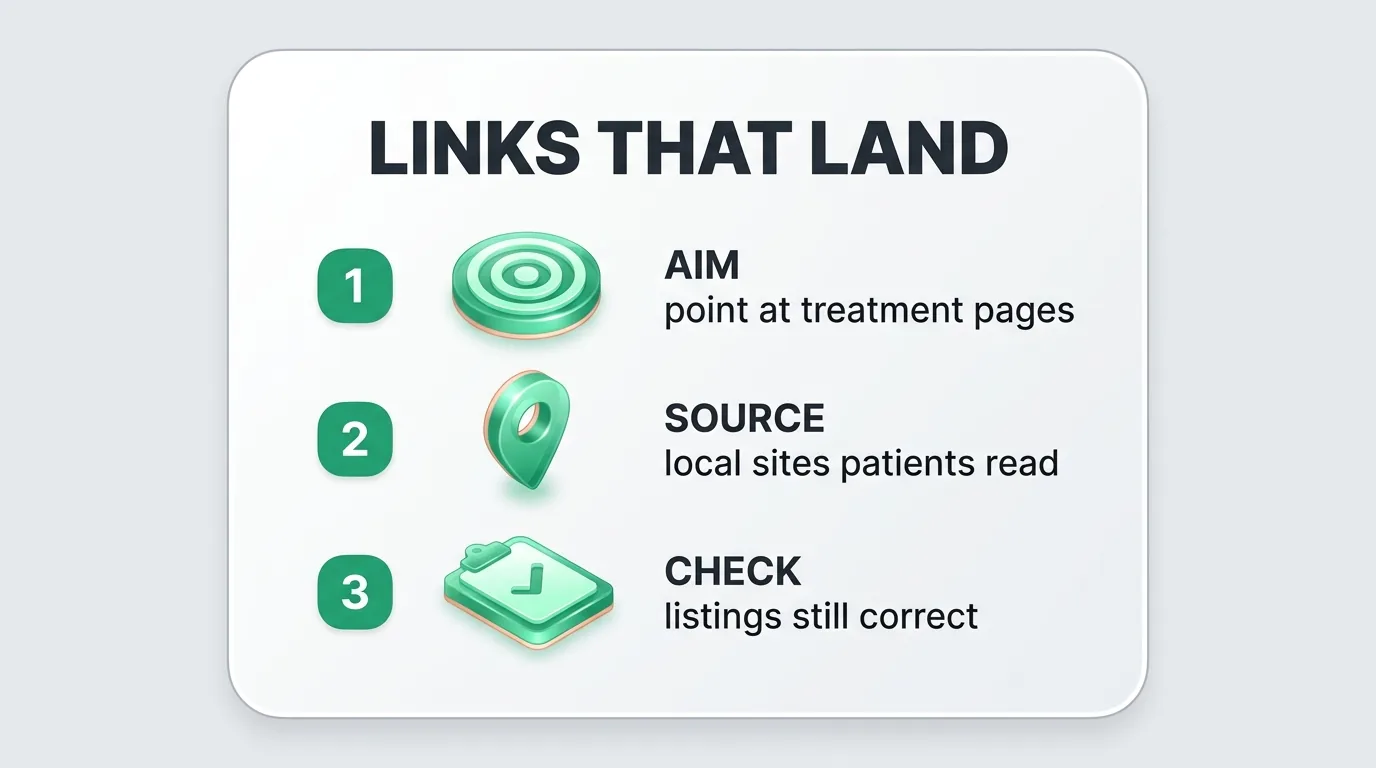
Most practices want more implant consultations, or more Invisalign enquiries, not just generic traffic. A backlink pointing to your homepage does less for a specific procedure than one pointing directly to your implants page. When you secure a guest article on a local wellness publication, link it to the treatment page you want to rank, not the front door.
Concretely: if cosmetic dentistry drives your revenue, a link from a local bridal magazine to your veneers page outperforms a link from a generic health directory to your homepage. Map your top three services, identify where their pages sit, then target link sources whose audiences already think about those procedures. Source relevance to the landing page is the variable most practices overlook entirely.
Know which links are worth the effort
Relevance, locality, and trust beat raw domain metrics
A link from a high-authority national health publication sounds impressive, but a link from the local Chamber of Commerce page often contributes more to a practice ranking for searches in a specific suburb. Google weights geographic relevance heavily in local results, which is why practitioners chasing domain authority scores sometimes build profiles that look strong nationally and perform weakly down the street.
Locality matters for the same reason your postcode appears on your listing: it signals that you serve a defined area. Combine that with topical relevance, a dental or health context, and you have a link worth pursuing. For how links feed into broader local visibility, local search for dentists covers the fuller picture.
Directories help only when the listing is real and maintained
A Yelp profile with an old phone number and no photos actively harms you. A patient checks the listing, finds outdated details, and books elsewhere before your front desk knows the enquiry existed. Directories earn their place in a link profile only when the information is accurate, the profile is complete, and someone reviews it at least twice a year.
The major healthcare directories, Healthgrades, Zocdoc, WebMD, carry enough domain authority and topical relevance to justify the maintenance time. Smaller niche directories often do not. Audit what you already have before adding more listings; a lean, accurate set outperforms a sprawling, inconsistent one.
A good link should strengthen a page you actually want to rank
I ran a clinic that ranked well for our practice name and almost nothing else. We had links, but they all pointed to the homepage. The service pages that drove revenue sat invisible. When we redirected outreach to land links on those specific pages, organic enquiries for implants shifted within a few months. The lesson was blunt: volume without targeting is decoration.
Pairing the right link target with the right search intent depends partly on knowing which terms patients actually use, so dental keywords worth ranking for should inform which pages you prioritise for links. Once a page ranks and traffic arrives, dental conversion optimization determines whether that visit becomes a booked consultation.
Protect the site from shortcuts and cleanup work
Spot the paid, spammy, and off-topic placements to avoid
A vendor emails you promising 200 dental backlinks for a flat fee. The sites they use are thin content farms with no real audience, no geographic connection to your practice, and no topical authority in healthcare. Google has been penalizing these link patterns for years. The short-term rankings bump, if it appears at all, collapses and often leaves a manual penalty that takes months to clear.
Off-topic placements carry a subtler risk: a link from a gambling site or an unrelated e-commerce page to your Invisalign page sends a signal that something manufactured is happening. Stick to sources a patient would recognise as credible within healthcare or your local area.
Audit the profile before you build more
Before adding a single new link, open a crawl tool and export your referring domains. Look for patterns: domains with no clear topic, foreign-language sites irrelevant to your location, links acquired by a previous agency you no longer use. A practice that inherited a spammy profile and kept building on top of it made the cleanup harder, not easier.
An audit typically takes two to four hours for a local dental site. You are looking for clusters of low-quality domains, sudden spikes in referring domains on a single date, and anchors that are over-optimised for exact match phrases. Building a credible profile starts from honest knowledge of what already exists. A broader content strategy that supports linkable assets is covered under dental content marketing.
When is disavow worth doing?
Disavow is not a routine maintenance tool. It is a last resort for situations where a cluster of clearly harmful links sits on the profile and cannot be removed by contacting the linking site. Google itself advises using the disavow file cautiously: a poorly constructed file can accidentally exclude links that help you.
Use it when you face a confirmed manual action citing unnatural links, or when a toxic cluster is large enough that it plausibly suppresses rankings. For most local dental practices, a clean audit followed by redirecting effort toward legitimate sources is enough. Tracking whether any of this work connects to revenue belongs under dental marketing ROI, where measurement frameworks sit outside this article's scope.
Build dental backlinks steadily, target the right pages, and the site earns the authority your best services deserve.