Clicks and consults are easy to buy, but signed treatment plans are not. See how to aim spend at real Phase I, teen, and adult starts without risking consent or compliance. The playbook below shows where the leaks are.

Running ads for months doesn't tell you which case type they actually filled.
Sort last year's exams into Phase I, teen, and adult piles, since one type almost always signs at a far higher rate than the others. Aligner ads often pull in complex bite cases that walk out once surgery comes up, wasting the exam slot you paid for.
Your traffic problem and your conversion problem look identical on a dashboard. Separate them before you spend anything.
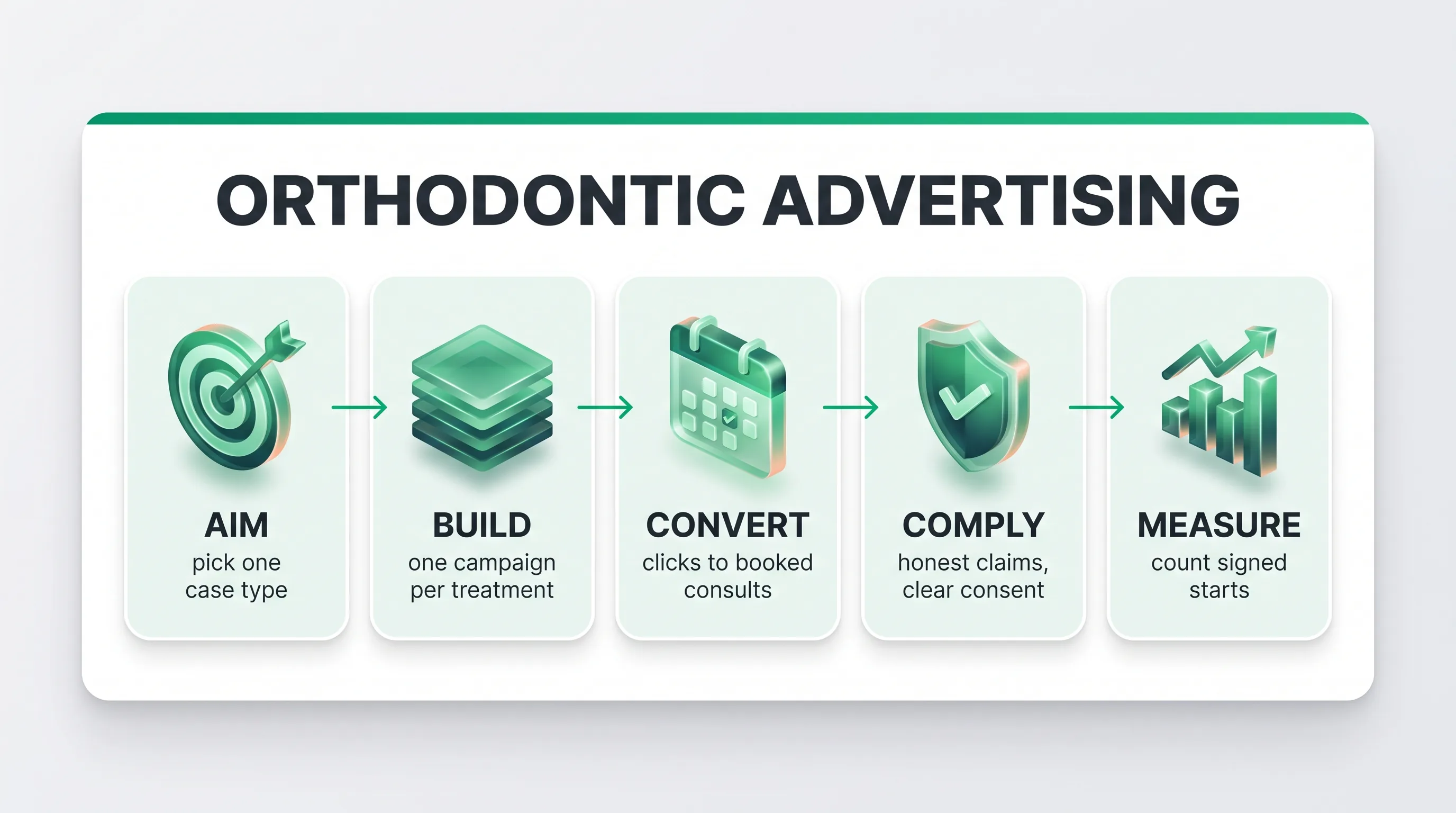
Open last year's new patient exams and sort them into three piles: Phase I, teen comprehensive, adult. Work out how many in each pile signed a contract and started. One pile almost always converts well above the others, and it is rarely the pile the ads were written for. You can run orthodontic advertising for months and still not know which of those three groups it actually filled. If adults book exams and then go quiet after the records appointment, more clicks buy you more silence. The rate you already get decides whether a new click has anywhere to land.
A target mix is a decision about chairs and staff, not an ambition. Phase I starts take a slot for a short active phase, then sit on an observation list for years. Adult aligner cases need longer appointments, refinement visits, and a doctor willing to talk through the relapse from braces they wore at fourteen.
Decide how many of each your current schedule and assistant coverage absorb, then size the budget to the gap rather than the whole board. If general dentists nearby already send steady early-treatment referrals, paying for those same clicks duplicates work, which turns a budget question into a wider one about where your teen and adult starts come from.
A parent searching your town plus braces sees a paid slot, a map of nearby practices, then the ordinary results. If your practice already shows up twice under those ads, the click you buy may be one you were getting anyway.
Check it before you bid. Open a private window, search the three terms you would buy, and write down where you land on each. Terms where you sit near the top need far less paid support than the aligner terms where a corporate chain and three general dentists sit above you. Paid search earns its keep where you are invisible or outgunned, and where it reaches people your existing pages never meet.
A mother pricing braces for her fourteen-year-old and a thirty-eight-year-old weighing clear aligners want opposite things from the same click. She needs the monthly amount and whether elastics mean more visits. He needs to know whether anyone at work will notice.
Put both in one campaign and spend drifts toward whichever clicks come cheaper, usually the braces terms, while the copy averages into something neither person recognizes. Split them at the campaign level so you control spend per appliance, and write each landing page in that patient's language: bracket choices and adjustment visits on one, attachments, wear time, and refinements on the other. The same split applies to your pages, so if you are deciding what to build first, weigh earning those searches without paying per click.
A general dentist spots a posterior crossbite at a seven-year-old's checkup and tells the parent to see an orthodontist. The parent searches that evening and finds practices talking about teen braces and adult aligners. Nothing explains why anyone would come in now.
The American Association of Orthodontists puts the first orthodontic check no later than age seven, which hands you a specific audience and a specific message: the mixed dentition, the crossbite with a functional shift, the erupting incisor with nowhere to go. Target parent demographics, keep the ad about the evaluation rather than appliances, and let the page answer the question they are really asking, which is whether treatment starts now or goes on an observation list. Most of those visits end in watching, and saying so plainly raises the share who turn up.
Aligner ads reliably pull in the cases aligners cannot finish. A skeletal Class III with a negative overjet, a severe anterior open bite, an impacted canine needing surgical exposure: those patients arrive expecting clear plastic and leave once you describe combined orthodontic and surgical treatment.
Write the limits into the ad and the page instead. Say that aligners handle crowding, spacing, and mild to moderate bite problems, and that some bites need fixed appliances or a joint plan with an oral surgeon. Name the records you take at the first visit, a panoramic and a cephalometric film, so the patient understands the plan follows the imaging rather than the advert. Honest exclusions cost you form fills and protect the appointments that convert.
A parent books the free consult your ad offered, arrives expecting to hear what it costs, and leaves with a separate appointment for records. She cancels that second one.
Free consultation means one thing to a patient: they find out what is wrong, what it costs, and when it can start. If your first visit is a short screening with records booked separately and the plan presented later, say that in the ad and on the page. Spell out the sequence, exam with the orthodontist, photographs and scan, then plan and payment options, and name who they will see. A parent who booked with a specialist and met a treatment coordinator instead will mention it, and not only to your front desk.
Adults carry the comparison into the consult room, usually with a direct-to-consumer aligner quote open on their phone. Answer it on the page, long before anyone fills in a form.
Name what the mail-order route skips: no radiographs, so bone loss or root resorption goes unseen; no attachments and no interproximal reduction, so rotations and crowding correct only partly; nobody watching the bite shift month to month. Then say what you do about relapse, because most of these adults wore braces as teenagers and quietly stopped wearing the retainer. A comparison written in your own clinical words persuades far better than a claim about superior care, and it screens out the patient shopping purely on the cheapest plastic.
Two questions decide whether a parent books: how long, and how much each month. Hiding both behind a form loses the people who were ready and keeps the ones who were only browsing.
Put your real ranges where they can be read:
Add what insurance assignment you accept and how a lifetime orthodontic maximum usually applies. A patient who reads the terms and books anyway has already accepted them, which changes the tone of the consult and shortens the distance to a signature.
The strongest case in your gallery usually carries the weakest paperwork. Think of the debond photo taken years ago, the patient who has since moved away, the consent form that covered the chart and never mentioned a paid ad.
Both the platform and your regulator care about that gap. Meta restricts before-and-after imagery in health categories, and dental regulators from the General Dental Council to state dental boards expect specific, current consent the patient can withdraw whenever they choose. Build a small library you can defend: written consent naming advertising use, the date, the appliance, and the right to pull out. Keep intraoral and extraoral photos unretouched, show the retention stage rather than debond day alone, and never pair an image with a claim about how fast it happened. One withdrawn consent should cost you a swapped asset, not a rebuilt campaign.
You competed for a residency place and spent years on biomechanics. The practice down the road bought a scanner and sat a weekend course. In a search result those two look the same, and vague superiority claims make it worse.
State facts and let them work: your specialty training, board certification where you hold it, years treating these cases, the share of your caseload that is orthodontic only. Skip anything that reads as disparagement of general dentists, which regulators treat as unprofessional and patients read as insecurity. The contrast worth drawing is clinical: who manages a skeletal discrepancy, who traces a cephalometric film, who plans extractions and anchorage. Put that in the copy and on the landing page, and the patient makes the comparison without you ever making it for them.
Retargeting someone who read your aligner page is lawful in most places and still feels wrong when the same ad follows them for weeks. Health interest is sensitive, and a shared family tablet turns your gentle reminder into a disclosure.
Cap frequency, keep the membership window short, and exclude everyone who has already booked or started treatment. Hold the creative general, your practice and your consult rather than the appliance they were reading about. Check which pixels fire on pages sitting behind a form or a patient portal, and strip tracking from anything that follows a submitted name. Platforms already prohibit targeting built on inferred medical conditions, and the cleanest test is whether you could show a patient their own audience list without wincing.
Your ad platform marks a conversion the second a parent submits a form. Your front desk meets that name hours later, and in between sit the callback, the voicemail, and the parent who booked somewhere else while waiting.
Count attended exams with records taken, which is why the report on your orthodontic advertising can look healthy while the schedule stays open. Push booked and attended status back from your practice management software into the platform, and a weekly manual upload does the job, so bidding chases the people who actually arrive. Then compare no-show rates campaign by campaign. Adult aligner campaigns and early-treatment campaigns for parents rarely attend at the same rate, and that gap names the message promising something the visit never delivered.
Partners want one number, and the right one is rarely the cheapest lead. Report spend divided by signed starts, split by appliance: comprehensive braces, clear aligners, Phase I.
A campaign with expensive clicks and a high signing rate beats a cheap one that fills the exam book with cases you refer out. Keep the figures to your own practice and leave published benchmarks alone, because markets differ too much for them to settle any argument in your boardroom. Once cost per start by appliance sits in front of your partners, their next question is usually how those starts stack up against the patients dentists send you, which is really a question about how paid consults sit against dentist referrals.
Pull last month's spend by campaign and check whether the appliance split matches the case mix your schedule can actually absorb.
We review your pages, search visibility and enquiry path, then show you what to fix first.
.svg)