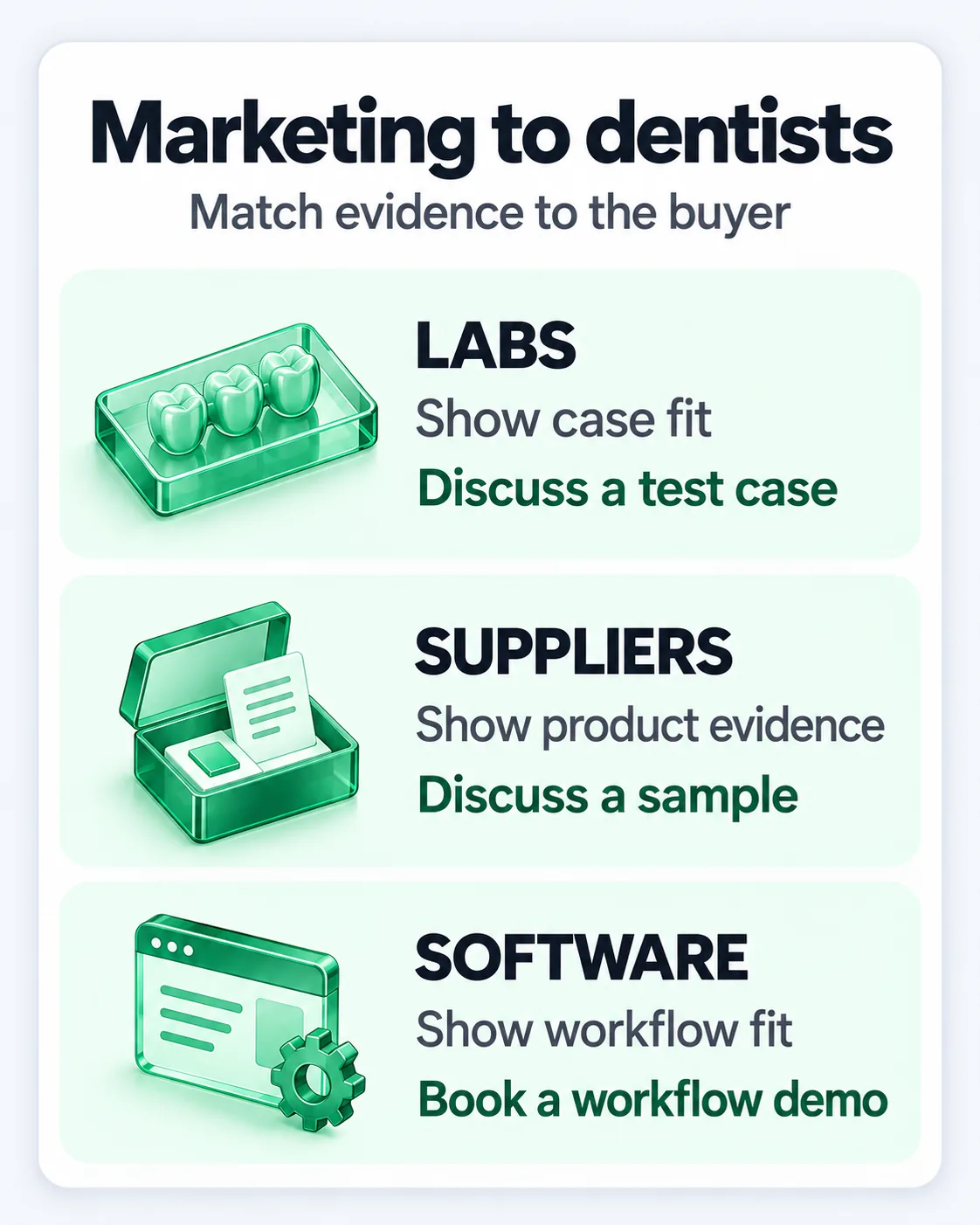
Marketing to dentists starts with the buying decision your product or service supports. A dental laboratory needs to explain a working relationship. A supplier needs to make a product and purchasing arrangement easy to evaluate. A software company needs to show how its product fits a real workflow.
This guide is for businesses selling to dental professionals, including laboratories, suppliers and software vendors. Use it to choose an account segment, identify the people involved, build the right evidence and connect the campaign to a sales step you can track.
Start with one buying decision
“Dentists” describes a profession. A campaign brief also needs a product, a reason to evaluate it and a person who can act. Start with a sentence your sales team can verify: “We help this type of practice evaluate this offer when this situation occurs.”
For a laboratory, the situation might be a team reviewing its submission workflow or adding a service. For a supplier, it could be a change in product requirements or purchasing arrangements. For software, it might be an operational task that the current system does not handle well. These are hypotheses to investigate with actual account information, not events to invent in a personalized message.
Choose one priority segment for the first campaign. An independent practice, a specialist group and a dental service organization may have different approval processes. Record what you know, what came from a public source and what still needs to be asked.
Match the vendor, buyer, proof and next step
Use this matrix as a briefing worksheet. The roles are examples to confirm for the account, not a claim that every practice buys in the same way.
On small screens, scroll the table horizontally to see every column.
Campaign design by vendor type| Business selling to dentists | People to identify | Question the offer must answer | Useful evidence or content | Next step |
|---|
| Dental laboratory | Prescribing dentist, owner, practice manager; group procurement where relevant | Will this laboratory's service and working process fit our requirements? | Verified case submission guide, material and workflow information, service terms, documented examples with permission | Discuss a suitable case and confirm requirements before submission |
|---|
| Supplies or equipment vendor | Clinical user, purchasing or inventory lead, owner; technical reviewer when needed | Does this product meet our requirements, and can we buy and support it on acceptable terms? | Specification comparison, compatibility information, available documentation, ordering and support terms | Request a product-specific quote or an appropriate evaluation |
|---|
| Dental software vendor | Workflow owner, practice manager, end users, IT or security reviewer, budget holder | Will it handle our workflow and fit our systems, team and purchasing requirements? | Workflow demonstration, verified integration list, implementation responsibilities and relevant technical documentation | Book a demonstration around a named workflow |
|---|
The difference is practical. A laboratory submission guide does not resolve a software integration question. A generic demo invitation does not answer which product a purchaser needs. The resource and the call to action should advance the same decision.
Map the people involved before choosing the message
Separate the person who experiences the problem from the person who approves the purchase. Ask the sales team who raised the last relevant inquiry, who requested further information, who reviewed terms and who authorized the order.
Turn those answers into a short account note:
- User or clinical evaluator: what must the product or service do in this setting?
- Operational reviewer: what changes in ordering, submission, training or day-to-day use?
- Technical reviewer: which specifications or system requirements need verification?
- Commercial approver: who assesses the price, purchasing terms and commitment?
One person can hold several roles. A larger organization may separate them. Let the account evidence determine the map instead of assuming the dentist receiving an email controls every part of the purchase.
Build a proof pack your sales team can stand behind
For each claim, keep the source, product version, market, date and approval owner beside the draft. Product specifications need the current product documentation. Service promises need the actual commercial terms. A customer example needs a clear scope, permission and a distinction between what was delivered and what was measured.
If a question has no verified answer, route it to the right person. Do not fill the gap with “seamless integration,” “guaranteed turnaround,” “clinically proven” or a promised saving. A useful page can state which documentation is available and what the evaluation will establish.
A practical pack might include a product or service overview, a workflow or specification sheet, one substantiated example and the questions needed to prepare a quote or demonstration. Keep the pack small enough for the buyer to use and specific enough for sales to answer the next question.
Connect search, content and outreach to the same offer
Search pages: answer an identifiable commercial question
Map searches to their intended page. A product-category query belongs with the relevant range. A comparison query needs stated criteria and sourced differences. A supplier query needs the service area, offer and inquiry path. Do not publish several near-identical pages with different headings and the same purpose.
For a catalog, check that category pages link to the products buyers should discover. Google says it generally does not submit searches into a site's search box while crawling, which makes linked navigation important. See Google's ecommerce navigation guidance.
Content: make evaluation easier
Choose the asset from the buyer's unresolved question. A laboratory can explain its submission process. A supplier can provide a comparison using verified specifications. A software company can show a workflow with the actual product. Each resource should lead to a relevant commercial page or conversation.
Outreach and partner channels: test the route to that resource
Email, professional networks, events and partner introductions are possible routes. Select them from the audience you can actually reach and the permissions and operational setup available for the market. There is no universal best channel in this worksheet. Track the qualified responses and subsequent sales steps for the channel you test.
Keep the message consistent with the landing page. If the message offers a submission guide, deliver the guide. If it offers a workflow demonstration, make the workflow clear before asking the buyer to schedule it.
Two examples of work delivered for healthcare businesses
Flora Dental Lab: content a practice customer can use
Forge delivered a 19-page whitening playbook and download page for Flora Dental Lab in September 2026. Flora is based in Slough and serves dental practices in England. The guide helps its practice customers explain and market their whitening service.
This is a B2B resource with a downstream patient audience: the laboratory reaches the practice by providing something the practice can use. The published guide demonstrates content delivery. It is not evidence that a particular number of practices ordered from the laboratory. View the playbook page and read the Flora project.
Biosil: distinguish practitioners from distributors
Forge's work for health product brand Biosil includes Shopify content and separate practitioner and distributor entry routes. A professional considering the product and a business considering distribution need different information and different follow-up.
The English-language website and French dental outreach are distinct workstreams. This example demonstrates site and content structure, without claiming US sales outcomes or recurring customers. Read the Biosil build report.
An illustrative campaign brief for a dental laboratory
The following is a planning example, not a campaign sent by Forge or a record of measured performance.
On small screens, scroll the table horizontally to see every column.
A focused campaign brief| Brief element | Example to validate |
|---|
| Offer and segment | One laboratory service for independent practices in the laboratory's confirmed service area |
|---|
| Buying question | What would our team need to prepare, submit and manage a suitable first case? |
|---|
| People | Prescribing dentist and person coordinating laboratory submissions; confirm who approves a new supplier |
|---|
| Resource | A submission checklist reviewed by the laboratory, linked to accurate service and contact information |
|---|
| Evidence needed | Actual submission requirements, available service, ordering terms and a staff member able to resolve questions |
|---|
| Call to action | Discuss whether an upcoming case fits the laboratory's service and requirements |
|---|
| Success event | A relevant practice enters a qualified service discussion; an accepted case is recorded separately |
|---|
Build the sequence around that brief:
- Introduce the resource. Explain the submission question it helps answer, identify the relevant service and link to the checklist.
- Resolve one practical question. Use a documented requirement from the checklist to help the buyer assess fit. Invite a question instead of inventing urgency.
- Offer the next conversation. Let the practice discuss a suitable case with the laboratory. Keep qualifications and commercial terms visible where they matter.
The sending schedule, audience permissions, exclusions and stop rules belong in the actual campaign setup. This example supplies the argument and asset flow; it does not authorize sending.
Measure the business step, not just the interaction
Agree the event definitions before launch. A page visit, a guide download, a reply and a new account are different events. For a laboratory, record qualified practice conversations, accepted cases and subsequent orders separately. For a supplier, distinguish a quote request from an accepted order. For software, distinguish a demonstration request from an attended demonstration, an opportunity and a signed agreement.
Keep the account, source, campaign, date and outcome connected where your systems support it. Mark unknown attribution as unknown. Review search visibility and content engagement alongside the sales record, without treating either as proof of revenue on its own.
Turn the buying decision into a workable campaign
Forge can help define the buyer journey, map relevant pages and prepare content from the evidence your team can supply. Our B2B healthcare marketing approach connects the diagnostic, content plan and agreed execution work.
Bring the product or service, target market, buyer roles, existing pages and the questions your sales team keeps answering. From €1,200 per month. Free diagnostic. No minimum-term commitment. Scope, fees and terms are confirmed in a written proposal. No territorial exclusivity is included by default for laboratories, suppliers or software companies.
Request your free B2B healthcare diagnostic