.svg)

What if new patients could find you while you sleep, without buying more ads?
When you show up first on Google for treatments in your city, you become the easy choice. Good pages, clear calls, and a strong Google profile quietly fill your schedule. Small, steady improvements online can lower your costs and keep your chairs busy all year.
✔ Update your Google Business Profile today (hours, photos, services, clear description)
✔ Create simple pages for key treatments plus your city name and add clear ways to book
✔ Track which calls and forms come from Google so you know what truly brings new patients
Pick one step from this list and do it this week so your practice starts showing up first when nearby patients search for help.
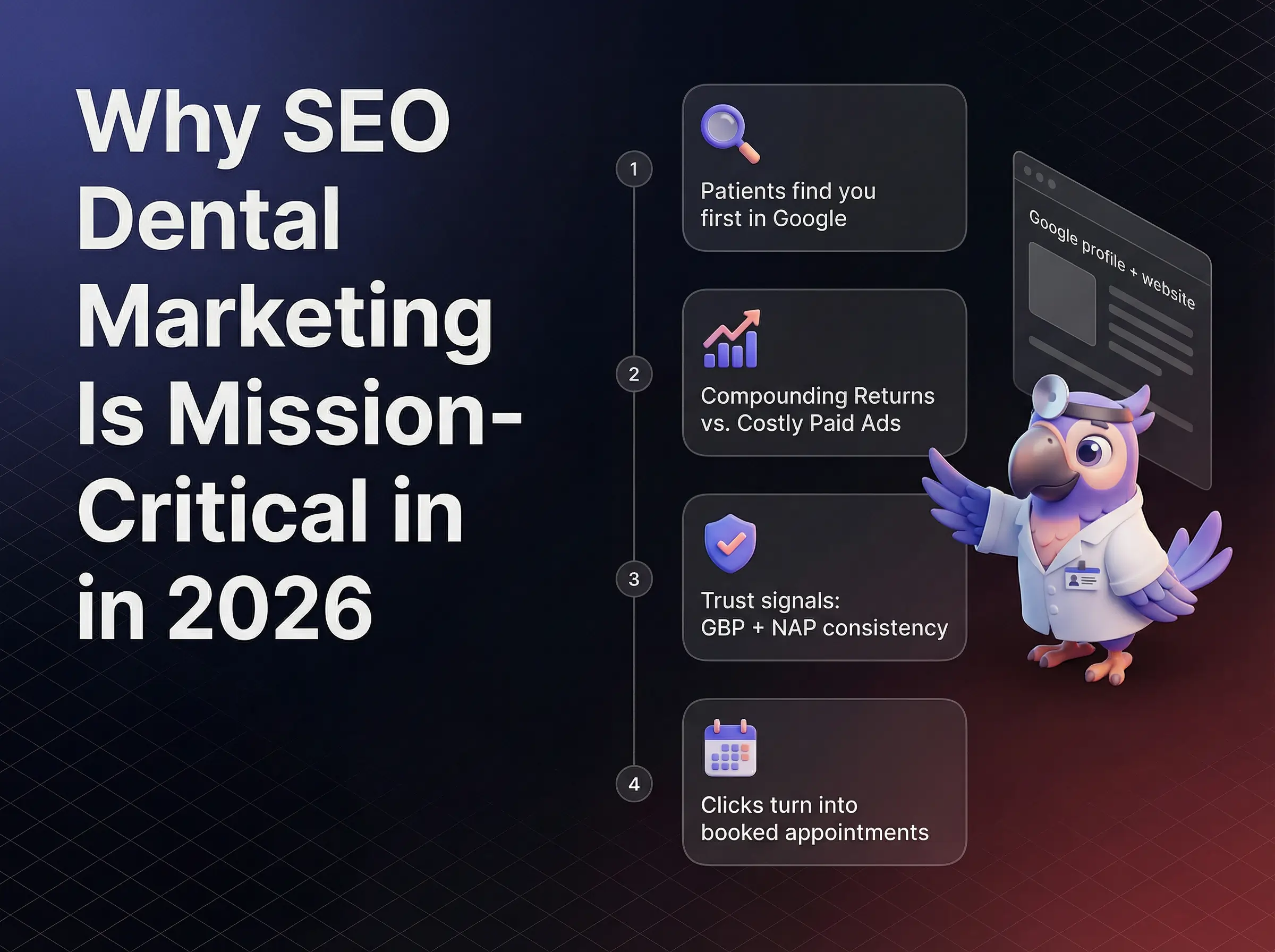
Patients are searching right now.
The practices they see first feel like the only choice.
In 2026, seo dental marketing is no longer optional for growth minded practices.
It is the engine that keeps chairs full, calendars booked, and production steady, even when paid ads get more expensive.
Used correctly, it turns your website and Google presence into a predictable source of new patient appointments.
You have likely felt the frustration of pouring budget into ads, watching clicks spike, then seeing everything drop the moment the spend pauses.
At the same time, competitors with strong search visibility sit at the top of Google and collect the highest intent patients without fighting in every auction.
This gap creates real pressure on front desk teams, on production goals, and on long term practice value.
The opportunity is simple to describe and challenging to ignore.
When your practice shows up first for core treatments in your city, you become the default option for patients who are ready to schedule right now.
That is exactly what focused dental SEO delivers.
Your ads stop the second the budget runs out.
Your SEO keeps working while you sleep.
For modern dental practices, the marketing channel with the lowest cost per new patient over time is usually organic search.
Top competitors invest heavily in search visibility because it compounds, while paid traffic often plateaus or declines in efficiency.
Strong rankings for core terms link directly to booked treatments, not just traffic.
When your website appears in the top three for services such as Invisalign or implants, those pages tend to attract visitors who are already comparing providers.
With clear calls to action, online booking, and tracked phone numbers, a significant share of those visits convert into consultations.
This pattern repeats daily, creating a steady baseline of new opportunities.
Relying only on paid media leads to constant budget tension.
Costs rise, click quality varies, and competitors with deeper pockets crowd the same auctions.
By contrast, consistent SEO work builds authority in your market that is harder for others to displace.
A recommended approach for healthcare business owners is to allocate a fixed portion of monthly marketing budget to SEO, then protect that investment for at least twelve months.
This treats search as an asset, not a short term test.
Dental SEO builds a compounding asset, while paid ads only rent short term attention.
Imagine if every blog post and service page you publish could reduce your future dependence on ads.
That is the practical effect of compounding SEO.
Competitor case studies show that practices with strong organic rankings often acquire new patients at a lower average cost than those leaning heavily on pay per click.
As more high quality pages rank, each additional patient costs less to acquire.
Paid campaigns rarely show the same curve.
SEO does require patience.
It demands content, technical improvements, and ongoing optimization.
However, once a treatment page reaches and holds a top position, it can generate new patient inquiries for months without incremental click fees.
Are you comfortable letting a competitor enjoy those compounding gains while your practice pays full price for every visit?
Ranking is not enough.
The real value appears when search clicks become appointments.
Patients often start with informational queries such as clear aligner costs or best dentist near them.
Well structured treatment pages answer those questions clearly, show proof through reviews, and guide visitors into a simple next step.
This pathway can be a call, an online booking tool, or a request form that feeds into your practice management system.
When calls, forms, and bookings are all tracked, you can see exactly which keywords and pages drive real production.
This clarity turns SEO from a vague marketing activity into a measurable revenue channel.
What would change if you knew precisely which three keywords reliably produced the highest value new patients each month?
Your website is not the only place patients meet your brand.
Your Google Business Profile often appears first.
For many local searches, especially on mobile, patients interact with Google profiles before they ever click through to a website.
Strong category choices, accurate details, and active content on your profile can place your practice at the center of that journey.
Competitor benchmarks show that a large share of discovery happens directly from profile categories and map results.
When your profile is incomplete or outdated, it signals neglect to both Google and patients.
Inconsistent hours, missing photos, or weak descriptions reduce trust and lower engagement.
The result is fewer calls and fewer direction requests, even if your clinical care is excellent.
Optimizing this asset is one of the fastest ways to lift visibility for high intent local searches.
It also supports every other part of your seo dental marketing strategy.
Certain profile fields carry more weight than others.
They directly influence how and when your practice appears in search.
Priority areas include your primary and secondary categories, a clear and compelling business description, accurate hours, an active questions and answers section, and authentic photos that reflect your real environment.
Each of these elements helps Google understand what you offer and helps patients feel confident enough to contact you.
Practices that regularly update these fields tend to see higher profile views and stronger engagement metrics.
Even simple actions, such as refreshing photos or tightening your description around core treatments, can produce measurable lifts in clicks and calls.
If someone in your area searched for emergency dentist tonight, would your profile clearly show that you are available and ready to help?
Search engines reward clarity.
They penalize confusion.
When your name, address, and phone number differ across directories, it creates doubt for both algorithms and patients.
Consistent NAP data across citations, your website, and your Google profile signals that your practice is stable and trustworthy.
Image optimization also plays a role in local visibility.
Geo tagging photos with your location and uploading them to your profile and key pages can offer another small but meaningful local relevance signal.
Combined with consistent NAP, these details help you compete in crowded city or neighborhood markets.
Have you audited your top twenty directories and social profiles recently to confirm that every detail exactly matches your Google listing?
Patients are not searching for generic dentistry.
They are searching for specific solutions in specific locations.
Local content that mirrors real questions in your community positions your practice as the obvious answer.
Geo targeted service pages, location based blog posts, and simple FAQs can all rank for terms that matter most near your practice.
This is where a focused dental SEO marketing agency often starts.
When your content speaks directly to the needs of people in your city, time on page rises and conversions follow.
Patients feel understood and see that you regularly handle the treatments they are considering.
Treatment pages should be built around how patients actually search.
That usually means pairing the procedure with the city or neighborhood.
For example, a page about Invisalign can be structured around terms such as Invisalign in your city, clear aligners cost in your city, or best Invisalign dentist nearby.
The content can walk through benefits, candidacy, process, cost ranges, and financing options in clear, non technical language.
Strategic headings, internal links, and embedded reviews help that page compete for multiple related searches.
This structure also makes it easier for front desk teams to share links with interested prospects during calls.
If a patient landed on your main implant page today, would it fully answer their concerns or simply list generic bullet points?
Your blog is not just a news outlet.
It is a powerful SEO tool when shaped around local questions and timing.
Effective content clusters often include seasonal topics, community focused pieces related to oral health events, and detailed answers to common patient queries around sensitivity, whitening options, or treatment timelines.
When combined with city or neighborhood mentions, these articles help your practice appear across a wider range of search terms.
Using tools such as Google Trends and query data from Search Console, you can prioritize topics that already show traction in your area.
This approach aligns your content calendar with existing demand rather than guessing blindly.
What would happen to organic traffic if every blog post for the next quarter aligned with a real query pattern that patients in your city already search each month?
Random articles rarely build authority.
Strategic content clusters do.
Pillar pages serve as comprehensive hubs for core treatments such as implants, veneers, or orthodontics.
Supporting articles then explore specific questions, risks, and logistics in more detail.
Together, this network signals expertise to search engines and provides a rich learning path for patients.
Start by identifying the three to five treatments that matter most to your production goals.
Each deserves a central page that goes far beyond a short description.
A strong pillar page can cover indications, process steps, healing timelines, cost factors, and financing options, while weaving in photos, reviews, and plain language explanations.
Related articles can then answer focused questions such as implant cost ranges, candidate suitability, or maintenance tips.
This architecture clusters topical relevance and increases your chance of ranking for a wide set of long tail queries.
It also gives your team a credible resource to share with patients who want to research before scheduling.
Which treatment line, if ranked across twenty related search terms, would most transform your revenue over the next year?
Internal links are quiet power tools in dental SEO.
They guide both patients and search engines through your most important content.
Contextual links from blog posts into related service pages help concentrate authority where it matters most.
Links back from those service pages into the pillar hub reinforce the structure.
Clear anchor text that reflects the target keyword gives additional clarity.
Practices that intentionally plan these pathways often see stronger performance for key treatments without adding new content volume.
In many cases, restructuring internal links offers faster gains than launching entirely new pages.
Have you recently mapped how many clicks it takes for a visitor to reach each high value treatment page from your homepage or blog?
The practices winning in search are not always the ones with the biggest budgets.
They are the ones that treat SEO as a long term growth channel.
With seo dental marketing evolving quickly, now is the moment to decide whether your practice will lead or chase.
You can begin by upgrading your Google profile, strengthening core treatment pages, and tracking the real value of every new patient from search.
If support is needed, partnering with a specialized dental SEO marketing agency can accelerate the process and prevent expensive trial and error.
The key is to choose a partner that understands healthcare regulations, local search behavior, and the unique economics of dental production.
What is the next concrete step you will take this month so that search visibility becomes a reliable asset for your practice, rather than a lingering concern?
.png)
I now help healthcare providers build predictable patient acquisition systems.
I write about healthcare growth, high-value patient funnels, and what actually works in today’s digital landscape.
Follow me👇
.svg)
