.svg)

Right now, the next high value patient in your town is clicking on someone’s ad.
Most people search on their phones, tap the first dentist they see, and book in minutes. If your practice is not in those top spots, a neighbor’s office is getting that call, that implant, that smile case.
PPC lets you show up first for “dentist near me,” emergencies, implants, and cosmetic work, with a clear offer and click to call. You control budget, hours, and areas, and you can see exactly which clicks turn into real treatment.
✔ Run simple ads for “dentist near me,” “emergency dentist,” and one top service (like implants or Invisalign)
✔ Use call tracking so you know which ads bring real patients, not just clicks
✔ Check results every month and move budget to the ads that lead to booked treatment
Start now with one focused PPC campaign for your best service and track every call and booking so you can quickly grow the patients and cases you really want.
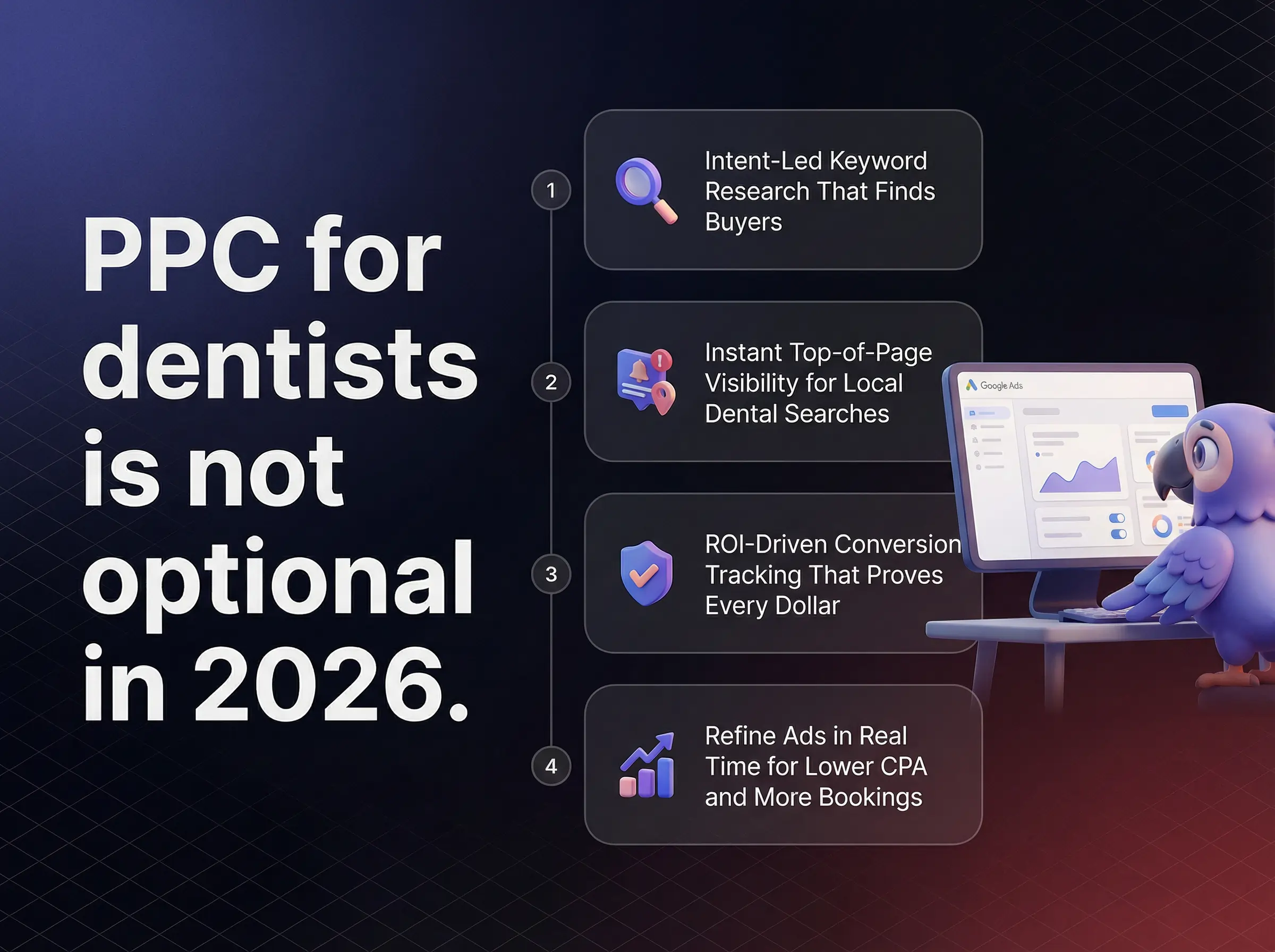
PPC for dentists is not optional in 2026.
It is the channel that decides who gets the next high value patient.
Patients now search from phones, in cars, and between meetings.
They see paid results first, tap once, and book or call within minutes.
If your ads are not there, another local practice captures that demand.
That is why a focused dental marketing agency treats PPC as the front line of patient growth.
It gives you fast visibility, precise control, and measurable ROI in a crowded local search landscape.
You stop guessing which ads work and start seeing which campaigns produce booked treatment.
The pressure is real.
You feel it every time a chair sits empty or hygiene days run light.
You may already invest in SEO, referrals, and print, yet still watch competitors appear above you whenever someone searches "dentist near me."
There is frustration when marketing spend feels fuzzy and slow to pay off.
Office teams are tired of leads that never answer or price shoppers who vanish after one call.
At the same time, there is a clear desire for growth, more implant starts, and a fuller cosmetic schedule.
PPC answers those pressures by meeting patients at the exact moment they raise their hand for help.
Click level tracking connects each new inquiry to a specific keyword, ad, device, and time of day.
That gives you insight into what is really filling the schedule and what is only burning budget.
PPC for dentists works best when every click is tied to booked treatment, not just traffic.
The central advantage is intent.
Organic rankings can attract broad, early research traffic, which still has value.
PPC can be engineered to prioritize people who are ready to call, book online, or request financing today.
In a mature market, speed and clarity matter more than ever.
Campaigns launch in days, not months.
Bids, locations, and schedules update in real time, so your practice can respond to new competitors and changing demand without rebuilding the entire strategy.
One recommended approach for healthcare business leaders is to treat PPC as a controllable patient acquisition engine, with clear targets for cost per new patient and revenue per booking.
That mindset turns marketing from a cost into a predictable investment.
What would change for your practice if every marketing dollar could be traced directly to new production on the calendar?
Patients do not scroll as far as they used to.
They tap what they see first.
In 2026, Google automates more of the results page than ever.
Paid listings, map packs, and AI summaries crowd organic links down the screen.
For local dental searches, this means PPC is often the first and sometimes the only thing patients really notice.
That is why practices that treat PPC as a primary growth channel surge ahead of those that rely on organic rankings alone.
Visibility at the top of the page translates directly into more calls, more form submissions, and more booked consultations.
A parent with a child in pain will not scroll through ten links.
They will tap one of the first practices they see.
Heatmap studies consistently show the majority of clicks cluster on the top paid positions and the map pack.
For dentists, that means PPC for dentists is the gateway to the attention zone where most decisions happen.
Organic listings still matter, but they rarely win the initial eye contact alone.
PPC lets your practice appear immediately for competitive terms like "dentist near me," "emergency dentist," and "Invisalign cost."
Instead of waiting months to climb organic rankings, you can secure top placement and start capturing demand within days.
Modern campaigns also leverage ad extensions that add sitelinks, call buttons, and location details directly into the search results.
Patients see your phone number, map pin, and key services before ever visiting your website.
This reduces friction and encourages immediate action.
If most of your future patients are clicking in the first three seconds, where does your practice appear in that window today?
Not every click has the same value.
A person searching "toothache causes" behaves very differently from someone searching "same day emergency dentist near me."
Smart dental PPC strategy separates these very different intents into dedicated campaigns.
High intent keywords focus on phrases such as "dental implants financing," "teeth whitening special," or "Saturday emergency dentist."
Each ad and landing page speaks directly to that treatment, price range, and urgency level.
This treatment led structure filters out casual browsers and attracts patients who are ready to book specific, high value procedures.
Teams can then prioritize these leads and design follow up processes that match their expectations.
For example, emergency leads may route to a direct call queue, while cosmetic leads receive quick online scheduling options.
In 2026, search platforms reward relevance.
Ads that tightly match intent typically receive higher quality scores, lower cost per click, and stronger conversion rates.
Every layer works together to align your marketing with the exact patient you want in the chair.
How many of your current clicks are from the right patients, and how many are just curious visitors who never planned to book?
Some marketing channels are slow and hard to measure.
PPC is neither.
For dental practices, the core appeal of PPC is speed and control.
You can move from campaign launch to first inquiries in a matter of days.
At the same time, you can choose exactly how much to invest, which treatments to feature, and when to show your ads.
When compared with SEO and print, this level of flexibility lets a practice test ideas quickly.
You can validate whether a new whitening offer resonates or if there is enough search volume for a niche implant service before committing heavy resources.
PPC removes the long lag between marketing decision and measurable outcome.
Campaigns often begin generating clicks on day one and inquiries within the first week.
Typical dental cost per click ranges can be higher than many local industries, especially for emergency and implant related terms.
However, you control daily budgets, bids, and geographic reach.
This means you can start with a modest budget, measure cost per lead and cost per new patient, then scale what works.
Daily and hourly pacing tools also keep spend within safe limits.
If calls slow down, budgets can be shifted to higher performing campaigns or new tests.
Nothing is locked in for months like a print run or billboard contract.
The question becomes simple.
How quickly would you like to validate whether a new patient offer can profitably fill your schedule?
Some services cannot wait months for awareness to build.
When a patient is in pain or ready for a smile upgrade, their decision cycle is short.
PPC lets your practice appear in that decisive instant with clear, urgent messaging.
Copy highlights same day appointments, extended hours, sedation options, or flexible payment plans.
Location targeting focuses your spend on nearby zip codes where patients can realistically visit your office.
Ad assets such as call extensions, location extensions, and structured snippets give patients more reasons to choose you.
They can tap to call, get directions, or see specific services without extra steps.
This is particularly powerful for mobile users who want fast answers and quick action.
When emergency, cosmetic, and implant patients are actively searching today, can they see you at the exact moment they are ready to choose?
PPC only matters if it supports real business outcomes.
Clicks alone do not pay staff or overhead.
A specialized dental marketing agency aligns every campaign with your production goals.
Targets might include more new patients per month, higher case acceptance for implants, or a fully booked hygiene schedule.
Each ad group, keyword, and landing page then maps back to one of those objectives.
To treat PPC as an investment, you need clear visibility from click to chair.
That begins with robust conversion tracking.
Phone call tracking attributes each inbound call to a specific keyword and ad.
Form submissions are tagged by treatment interest, such as Invisalign, implants, or whitening.
Online bookings can be flagged based on appointment type, which allows you to calculate revenue per campaign.
This structure turns reports into meaningful financial insights.
You can see which campaigns bring in high value treatments and which attract mostly low margin visits.
Over time, budgets are shifted toward the keywords and ads that generate the highest treatment value per lead.
With this level of clarity, how much easier would it be to decide where your next marketing dollar should go?
Not every patient searches at the same time or from the same place.
Geo targeting and scheduling refine your reach so you show up where it matters most.
Ads can focus on specific zip codes, neighborhoods, or radius zones around your office.
This reduces wasted spend on regions that are unlikely to travel to your location.
It also helps multi location groups tailor messaging and offers by site.
Scheduling features limit ads to the hours when patients are most active and your team is ready to respond.
For example, early morning and late night periods often perform well for emergency searches, while evenings and weekends can be strong for cosmetic interest.
Aligning ad schedules with real call and booking data keeps your budget focused.
When your ideal patients are searching, are your ads live in that moment or sitting offline while competitors take the lead?
The right keyword list is the difference between full schedules and wasted spend.
Every term you bid on shapes who sees your brand and at what cost.
Strategic research in dental PPC looks beyond volume.
It emphasizes intent, competition level, and historical conversion performance.
Combined with careful negative keyword use, this keeps your campaigns focused on buyers instead of browsers.
Search terms reveal what a patient actually wants.
Someone typing "toothache symptoms" is exploring possibilities.
Someone typing "emergency dentist open now" is ready to act.
Intent led research separates educational terms from urgent or transactional queries.
High value campaigns prioritize phrases with clear action signals such as "near me," "same day," or "cost" combined with specific treatments.
Lower intent terms may be used in limited remarketing or content strategies rather than core PPC.
Long tail keywords, such as "dental implant specialist in [city]" often bring lower competition and stronger leads compared with broad short tail terms like "dentist."
This mix of high intent and long tail coverage creates a cost effective base for growth.
Negative keyword lists then filter out research only or unqualified traffic.
If you looked at your current search terms, how many clearly show a patient who is ready to book and how many look like early research?
In competitive markets, patients often search practice names along with the city.
With careful strategy, you can appear alongside those branded searches.
Competitor conquest campaigns bid on rival names and related phrases in an ethical and transparent way.
Ads do not pretend to be that competitor.
Instead, they offer a clear alternative with strong points of difference such as extended hours, financing options, or specialized services.
This approach respects advertising guidelines while giving patients real choice.
It can be especially effective when other practices have weak online experiences or limited availability.
However, it must be monitored closely to control costs and maintain brand integrity.
If a potential patient searches a competing practice today, do they even realize your office is another option?
Clicks are only the first step.
Conversion happens when ad messaging and landing pages work together seamlessly.
Every element should reassure patients, reduce friction, and make the next step obvious.
This includes headlines, trust signals, mobile layout, and clear calls to action.
Small adjustments here can dramatically improve performance without increasing budget.
Most dental search traffic now comes from mobile devices.
If your landing experience is not built for small screens, you lose patients in seconds.
Mobile first pages load quickly, display clear headlines above the fold, and present a simple choice such as "Call now" or "Book online."
Sticky headers with a call button and map make it easy for patients to contact or locate your office while scrolling.
Forms are short, with only essential fields, so completion feels effortless.
Click to call functionality is critical for emergency and high intent traffic.
Patients should never need to copy and paste a number.
One tap should connect them directly to your team.
Is every step from ad click to confirmed appointment as fast and simple as it could be on a mobile phone?
Strong offers help your ads stand out in a crowded results page.
For dental PPC, promotions such as new patient exam packages or whitening bonuses often perform well.
Limited time or quantity framing can increase urgency when used responsibly.
For example, a whitening add on for new patient exams or special pricing for the first set number of implant consultations can lift click through and conversion rates.
The key is to align offers with high value treatments and to calculate the impact on overall profitability.
Performance data then guides which promotions to keep, rotate, or retire.
Over time, practices build a library of proven offers that reliably fill specific parts of the schedule.
This creates predictability in both patient volume and revenue.
If every major ad group had one proven, profitable offer attached, how much steadier would your new patient flow feel month to month?
PPC is not a set and forget channel.
It rewards ongoing refinement.
Dental practices that win with PPC treat their accounts as living systems.
They review data regularly, test new ideas, remove waste, and double down on what works.
The result is lower cost per acquisition and more predictable patient growth.
Raw metrics like impressions and clicks are only starting points.
Real insight comes from metrics that connect to chair time and production.
Key indicators include booked appointments, treatment value per lead, and cost per new patient.
No show rate and reappointment rate also matter, since they influence long term patient value.
When these metrics are tied to campaigns, ad groups, and keywords, you can see which parts of your account create the most business impact.
This clarity supports smarter budgeting and service line planning.
For example, you may discover that a modest implant campaign produces more lifetime value than a larger general dentistry push.
That insight can reshape your growth plan.
If your reports only list clicks and conversions, what crucial decisions are you making without the full financial picture?
Continuous optimization turns a good PPC account into a great one.
It involves frequent testing and steady removal of waste.
Negative keyword mining eliminates irrelevant queries that drain budget.
Ad copy testing compares different headlines, descriptions, and calls to action by device and audience.
Bid adjustments reflect seasonality, competitive shifts, and peak performance hours.
These changes compound over time.
Every small gain in click through or conversion rate lowers your effective cost per acquisition.
That means more booked patients from the same budget.
How often is your account reviewed with the explicit goal of lowering cost per new patient and raising total treatment value?
Many dental PPC accounts underperform for the same predictable reasons.
Fixing them can unlock significant gains without spending more.
A simple self audit can reveal where budget is leaking and where patients drop off before booking.
From there, targeted adjustments quickly improve results.
Broad, vague keywords are tempting because they show large search volumes.
In practice, they often attract the wrong audience.
Terms like "tooth pain" or "dentist advice" frequently come from people who want information, not appointments.
Clicks add up, but calls and bookings stay flat.
This inflates your cost per conversion and hides the true potential of PPC.
Stronger alternatives include combinations of treatment, intent, and location.
Examples are "emergency dentist [city]," "same day crown near me," or "affordable implants [city]."
Paired with a robust negative keyword list, these phrases concentrate spend on higher quality prospects.
If you pulled a search term report today, how many queries would you gladly pay for again and how many would you immediately block?
Even the best ad cannot overcome a poor landing experience.
Common pitfalls quietly depress your conversion rate.
Slow loading pages cause impatient mobile users to abandon before seeing your content.
Confusing navigation distracts visitors with too many choices and no clear next step.
Lack of obvious calls to action forces patients to hunt for phone numbers or forms.
High converting dental pages are focused and reassuring.
They state the benefit quickly, provide social proof such as reviews, and give one or two clear actions.
Contact options appear prominently, with mobile friendly placement and minimal friction.
Looking at your current PPC landing pages, would a first time visitor instantly know what to do and feel confident taking that step?
Every practice must decide how to manage PPC.
The choice is not one size fits all.
Some teams benefit from external expertise and technology.
Others prefer to keep a small, simple program in house.
The best approach depends on budget, growth goals, and internal bandwidth.
A specialized agency brings structure and scale that most in house setups cannot match.
This often starts with advanced tracking and compliance.
HIPAA aware call tracking preserves patient privacy while capturing essential marketing data.
Custom dashboards consolidate metrics from ad platforms, call systems, and practice software.
Teams can view performance by location, provider, or service line in one place.
Agencies also provide ongoing optimization processes.
These include regular A B tests, competitive monitoring, and proactive strategy adjustments.
For multi location or growth focused groups, this framework supports aggressive patient acquisition targets.
If your goal is to grow quickly or across several locations, could an external team shorten your learning curve and spread best practices faster?
In some cases, an internal approach is practical and efficient.
This is especially true for single location practices with modest budgets and stable patient flow.
If campaigns are small, limited to a few core services, and changes are infrequent, a trained internal coordinator can manage basic tasks.
The key is to maintain disciplined tracking and periodic audits, rather than letting accounts drift.
As goals expand or competition intensifies, many practices eventually layer in outside support.
The right model can also be a hybrid.
An agency designs the structure, tracking, and strategy while in house staff handle day to day tasks like reviewing calls and managing leads.
This blends scale with internal knowledge of your patients and operations.
Given your current stage and ambitions, which mix of in house involvement and external expertise offers the clearest path to predictable, profitable patient growth?
In 2026, PPC for dentists remains one of the fastest routes to measurable patient growth.
With the right strategy, tracking, and support, you can attract better leads, lower your acquisition cost, and gain full visibility into what truly grows your practice.
Schedule your free PPC strategy call - turn local searches into booked appointments and predictable new patient growth.
.png)
I now help healthcare providers build predictable patient acquisition systems.
I write about healthcare growth, high-value patient funnels, and what actually works in today’s digital landscape.
Follow me👇
.svg)
