.svg)

What if every money talk in your practice felt as calm and comfortable as a hygiene visit.
Dental sales training is really just better patient conversations. When each team member knows what to say, when to listen, and how to explain options clearly, patients feel safe choosing care, case acceptance goes up, and your marketing finally turns into real production.
✔ Give each role one simple job in the sale (scheduler sets the visit, clinician explains health, coordinator handles money)
✔ Use easy scripts to handle cost and fear so patients feel heard, not pushed
✔ Track a few numbers like case acceptance and no shows to spot where you lose patients
Start with one step this week, such as clarifying roles or adding a simple script, and watch patient confidence and accepted treatment begin to climb.
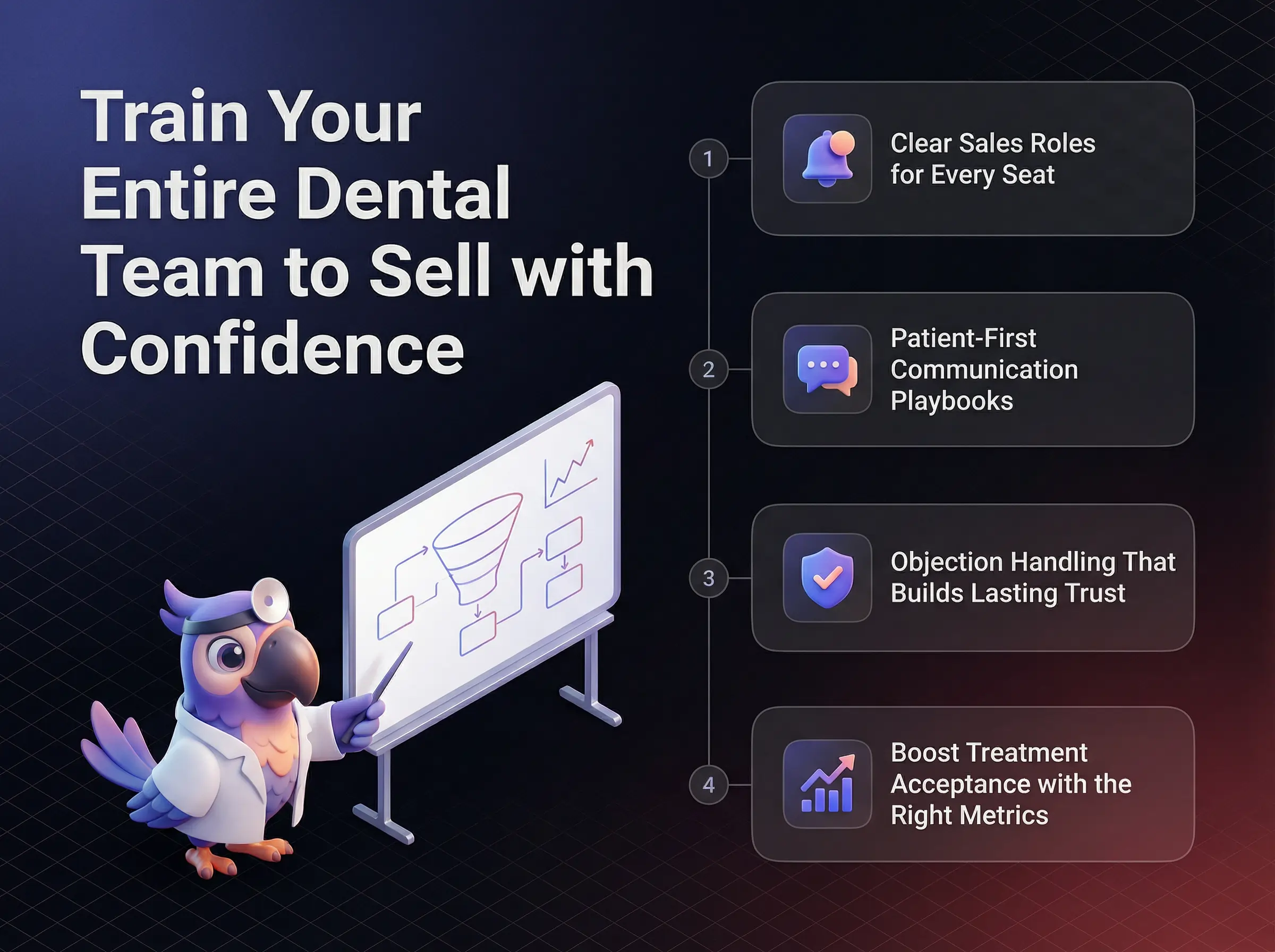
Dental sales training should not feel like sales at all.
It should feel like clear education, confident guidance, and patient choice.
As a growth focused practice or DSO, you need a team that communicates value clearly, handles money conversations without awkwardness, and closes cases without pressure.
This is where a specialized dental marketing agency approach to sales training changes everything.
Instead of isolated scripts, you gain a complete system for ethical conversion that aligns every touchpoint from first call to final signature.
Without structure, good leads leak out of the pipeline, high value cases stall, and your team feels uncertain every time a patient hesitates.
That uncertainty shows up in voice tone, body language, and rushed explanations that leave patients confused rather than confident.
Over time, this erodes trust, lowers case acceptance, and turns marketing spend into missed opportunity instead of booked production.
Effective dental sales training replaces that anxiety with clarity.
Your team learns exactly what to say, when to pause, how to listen, and how to guide patients to decisions that feel right to them.
The result is a calmer front desk, more decisive consults, and patients who thank you for helping them move forward.
Aligned dental sales training turns every conversation into a trusted, patient first decision moment.
As you review the frameworks below, consider where your current process breaks down.
The strongest gains often come from fixing a few key moments in the journey, not from changing everything at once.
High conversion practices are not built on a single closer.
They are built on teams where every role supports the sale in a clear, consistent way.
Modern DSOs increase production by assigning tailored sales responsibilities to each position instead of hoping one person does it all.
From call intake to clinical handoff, each step is intentional and measured.
Your practice can use the same approach without losing its culture or values.
When roles are vague, team members guess.
Schedulers over promise, clinicians under explain, and treatment coordinators try to rescue cases that were never framed correctly.
This creates friction, internal blame, and a frustrating gap between lead volume and actual starts.
When roles are defined, each person knows how they contribute to case acceptance.
The scheduler sets expectations and positions the consult as a strategic decision session.
The clinical team supports the recommendation with clear, jargon free education, while the coordinator guides logistics, finances, and follow up.
A recommended approach for healthcare business leaders is to document one core conversion responsibility for each seat, then review it weekly during brief huddles.
This simple rhythm anchors training into daily behavior instead of a one time event.
If your team already works hard, what would change if every person understood exactly how their words influence acceptance rates, not just appointment counts.
Patients feel the difference between a coordinated team and a disconnected one.
They notice when every conversation reinforces the same plan and outcome.
Clear sales roles remove mixed messages.
The scheduler focuses on curiosity and commitment to the visit.
The coordinator focuses on clarity of options and investment.
The clinical team focuses on health impact and realistic expectations.
This structure gives your staff confidence.
They no longer need to improvise or step outside their comfort zone.
Instead, they follow a proven framework adapted to your brand, services, and patient base.
How much production is currently lost simply because patients hear three different explanations for the same treatment plan.
The real power sits in how roles connect.
Alignment is what turns a good consult into a smooth yes.
Schedulers set up the story by capturing key motivators.
Clinicians reference those motivators during the exam, which makes the recommendation feel personal and relevant.
Treatment coordinators then link those same motivators to timing, financing, and follow through.
This cross role coordination eliminates gaps where patients drift, delay, or look elsewhere.
Your entire team carries a single, consistent narrative that keeps the patient focused on outcomes, not just costs.
The question is not whether your people care.
The question is whether your process makes it easy for them to support conversion at every step.
Patients can feel pressure from a mile away.
They can also feel when a team genuinely wants the best for them.
Ethical frameworks help your practice convert more treatment while protecting trust.
They replace outdated push tactics with structured, consent driven conversations.
The focus shifts from closing a sale to guiding an informed health decision that aligns with the patient’s goals and finances.
Many teams shy away from sales language because it feels aggressive or uncomfortable.
This often leads to weak recommendations, vague explanations, and a quick retreat at the first sign of hesitation.
Patients then leave uncertain, even if they were initially interested.
With patient first playbooks, your team learns how to speak with confidence and empathy at the same time.
They ask better questions, reflect back what they hear, and present clear options with no hidden agendas.
This helps patients feel safe enough to say yes without regret.
What would change in your production if every consult felt like a tailored strategy session rather than a rushed pitch or a technical lecture.
Strong communication does not happen by accident.
It follows patterns that can be taught, practiced, and repeated.
Patient first playbooks give your team structured language for difficult moments.
They cover how to validate concerns, normalize fear, and reorient attention toward long term outcomes.
They also teach respectful ways to explore budget sensitivities without embarrassment.
This keeps autonomy firmly in the patient’s hands.
Your role becomes that of a trusted guide who clarifies risks, benefits, and timing, then supports whichever path the patient chooses.
When communication shifts from defensive to collaborative, patients open up instead of shutting down.
High value cases succeed when patients can see and feel the difference a treatment will make.
They fail when presentations are rushed, confusing, or dominated by cost.
Ethical case presentation focuses on visuals, analogies, and real world comparisons that make complex treatment easy to understand.
Patients see what will happen if they act, as well as what may happen if they wait.
This clarity makes decisions feel logical instead of reactive.
Your team learns to slow down at key moments, ask for questions, and gently check for understanding.
Pressure fades because the patient sees the full picture and chooses from a place of confidence.
If case presentations today feel rushed or reactive, what would it be worth to your practice to standardize a calm, visual, patient led format.
Objections are not rejection.
They are signals that patients need more clarity, safety, or support.
Teams that avoid objections lose cases.
Teams that welcome objections and handle them well build loyal patients who refer friends and family.
With the right training, your staff can turn hesitation into deeper commitment instead of awkward silence.
Common objections usually fall into a few themes.
Patients worry about cost, timing, fear of procedures, or need for a second opinion.
Without a plan, your team either pushes too hard or backs off too quickly.
Structured objection handling equips them with scripts, questions, and mindset shifts so they can respond without sounding robotic.
They learn to stay calm, thank the patient for being honest, and explore what is really underneath the concern.
This turns the conversation into a partnership rather than a tug of war.
What if your team viewed every objection as proof that the patient is still engaged and considering treatment, rather than as a sign to give up.
Effective scripts are not word for word monologues.
They are flexible guides that keep your team grounded during stressful moments.
For example, when a patient wants to delay, a script can help your coordinator explore what they are hoping will change.
When a patient is confused about the procedure, a script can walk them through the steps using simple language and visual cues.
Checklists make sure no key detail is missed.
This consistency builds trust over time, especially for full arch, implant, and cosmetic cases where investment is significant.
With the right scripting, many objections that once ended the conversation become openings for deeper understanding and eventual acceptance.
Price and fear are often intertwined.
Patients are not just asking if they can afford treatment.
They are asking if the outcome is worth the emotional and financial risk.
Strong training teaches your team to connect cost to long term value.
For example, lifetime comfort, confidence, and function compared to years of temporary fixes.
At the same time, it provides calm reassurance about what the patient can expect throughout their experience.
By blending emotional intelligence with clear payment options, your staff can normalize financial conversations without discounting your value.
Patients feel understood instead of judged, which makes it easier to move forward.
How many high value cases have been lost in your practice, not because the price was wrong, but because the story around that price was incomplete.
You cannot improve what you do not track.
Treatment acceptance is no exception.
Top performing organizations measure specific sales metrics for each stage of the journey.
They know their full arch conversion rate, same day acceptance, and consult to start time.
That clarity turns vague goals into focused coaching.
Without data, every conversation about performance becomes subjective.
Some days feel busy, others feel slow, yet no one knows why.
Marketing campaigns get blamed when the real issue might be poor follow up or unclear handoffs.
With a handful of simple KPIs, you gain a dashboard for decisions.
You can see where leads drop, which providers convert best, and which coordinators need more support.
This makes growth feel controlled instead of chaotic.
If you looked at your current numbers today, would you know your true case acceptance rate or only your scheduled volume.
Full arch and other high ticket treatments deserve their own metrics.
The stakes and patient psychology are different from routine care.
Tracking full arch conversion from consult to start reveals where value is lost.
It shows whether the challenge lies in lead quality, presentation, pricing, or follow up.
From there, training can focus on the right skill gaps instead of generic advice.
Dashboards that tie conversion back to individual roles also increase accountability.
Each team member understands how their part of the process influences the final outcome.
When you can see a clear baseline, every incremental improvement in conversion has a direct and measurable revenue impact.
Same day acceptance, no show rates, and consult to close timelines are not just numbers.
They tell the story of how your sales process feels to patients.
If same day acceptance is low, your team may need stronger framing of urgency or clearer next steps.
If no shows are high, scheduling scripts or confirmation routines might need improvement.
Over time, your practice can build a simple KPI scorecard that becomes part of monthly reviews.
This keeps growth visible and helps your team celebrate real progress.
How different would your planning feel if you could forecast production based on proven conversion lifts, not just hopeful projections.
Every extra day between first contact and treatment start creates risk.
Competing offers, changing priorities, and uncertainty all grow in that gap.
A shorter, smarter sales cycle protects your marketing spend and accelerates ROI.
It focuses on speed with quality, not rushed decisions.
Patients move forward quickly because the path feels simple and supported.
Many practices unintentionally slow things down.
Leads sit in inboxes, consults are booked weeks out, and follow up is inconsistent.
By the time the team reconnects, interest has faded.
Structured processes for lead routing, prequalification, and follow up fix this.
Your team knows exactly how soon to contact, what to say, and when to offer the next step.
The experience feels proactive rather than passive.
Where in your current sales cycle do patients wait the longest, and what would it mean to cut that wait time in half.
The first phone call or form submission sets the tone.
It is the moment when curiosity becomes commitment.
Effective sales training gives your front office clear scripts for qualifying interest, capturing the right details, and booking promptly.
It also defines rules for routing high intent leads quickly to the right coordinator or location.
When patients feel taken care of from the first contact, they are far more likely to show up and engage.
The journey already feels organized and professional, which reflects well on your clinical care.
This starting point is one of the fastest ways to improve overall conversion without any new marketing spend.
Drop off is rarely caused by a single issue.
It is usually the result of small frictions that stack over time.
Training that maps each stage from lead to treatment start helps your team spot these frictions.
Maybe reminders feel too transactional, or follow up scripts sound generic.
Small improvements in message tone, timing, and empathy can have a large impact.
Reactivation tactics are especially valuable.
Gentle, personalized outreach to past consults can recover cases that once felt lost.
Consider how much unrealized revenue currently sits in your list of inactive or unscheduled treatment plans.
No two organizations are identical.
Your sales training should reflect that reality.
DSOs need scalable, repeatable frameworks across multiple locations.
Private practices need flexible strategies that match their unique market and brand.
Both can benefit from a modular approach that adapts to service mix and growth stage.
Generic training fails because it ignores your specific challenges.
Implant heavy practices, for example, face very different objections than hygiene focused offices.
Real impact comes from content that speaks directly to your patient base and your team’s current skill level.
Custom training design also improves adoption.
When your staff sees their real scenarios reflected in scripts and role plays, they lean in instead of tuning out.
This accelerates behavior change and ROI.
What would your ideal training program address first if it were built entirely around your top three production goals.
Format matters almost as much as content.
The right mix depends on your size, schedule, and culture.
Live virtual sessions are ideal for consistency across locations and busy teams.
On site intensives work well when you want rapid transformation and deep engagement.
Self paced online modules provide reinforcement and onboarding for new hires.
A blended approach often works best.
It combines the energy of live training with the practicality of digital resources.
This flexibility lets you maintain momentum even as staff, seasons, and service offerings change.
Training can and should be built backward from your targets.
If implants are the focus, scripting, visuals, and follow up center on long term value and stability.
If cosmetic is the focus, messaging leans into confidence, aesthetics, and life events.
Production tiers also matter.
Offices at early growth stages may prioritize basic call handling and simple financing conversations.
Advanced organizations may refine full arch consult flows or create dedicated roles for high value cases.
When every training element aligns with a specific financial objective, your team understands the why behind every new skill.
Which single service line, if supported by focused training over the next quarter, would create the most meaningful revenue shift for your organization.
Frameworks matter, but results matter more.
Your leadership decisions deserve concrete proof, not theory.
Across many practices, structured sales training has produced double digit lifts in acceptance and significant increases in collected production.
These gains come not just from more leads, but from better handling of the leads already in the system.
That is where the real leverage sits.
Case studies provide a clear window into what is possible.
They show how similar teams moved from inconsistent performance to predictable growth with specific playbooks and coaching.
They also highlight common mistakes to avoid.
Before and after comparisons bring this to life.
They reveal how metrics such as show rates, same day starts, and average case value shift when training is taken seriously.
What would it mean for your organization to see a 20 to 50 percent improvement in case acceptance without adding more marketing spend.
Relevant examples reduce risk.
They help you see how strategies translate into real schedules and bottom line numbers.
Detailed conversion snapshots can show how DSOs aligned multiple locations around one sales journey.
They can also show how solo practices used structured training to compete in crowded markets and win high value cases consistently.
These stories function as a roadmap.
They make it easier to prioritize which parts of the training journey to implement first.
Numbers tell a clean story.
They show what changed, by how much, and over what time frame.
Pre training metrics often reveal long consult to close times, low same day acceptance, and high drop off after diagnosis.
Post training metrics typically show shorter decision cycles, clearer follow up, and higher average case values.
When leadership can track these shifts in a simple dashboard, investment decisions around training and staffing become much easier.
Consider which metrics you would want to see move first to feel confident that your sales training strategy is working.
High value treatments require high trust closes.
Scripts alone are not enough.
Patients making significant financial decisions need a clear vision of the outcome and full confidence in the path to get there.
Your team must know how to guide that decision without pressure or apology.
This is where advanced closing skills become a competitive advantage.
Full arch, implants, and cosmetic cases involve identity, lifestyle, and emotion.
The conversation is about who the patient will become, not just what procedure they will receive.
Teams that can speak to that identity shift close more cases at healthier fees.
Training that integrates narrative, visuals, and structured next steps gives your coordinators and clinicians the tools they need to support these decisions.
Patients feel seen, not sold.
Imagine how many more comprehensive cases you could start each month if every high value consult ended with a confident, calm, and clear invitation to begin.
Clarity reduces fear.
It also reduces price sensitivity.
Strong presentations follow a simple structure.
They review needs, connect to desired outcomes, position the financial investment, and explain logistics in plain language.
Visual aids help patients picture their future, not just their procedure day.
Questions are encouraged, not avoided.
Your team learns to pause, check for understanding, and then confirm commitment with clear next steps.
When patients leave with a vivid picture of the result, cost feels like a means to a meaningful end, not a random number.
Facts inform.
Stories move people.
In high value treatment conversations, identity based storytelling is a powerful tool.
Your team can share anonymized examples of patients with similar goals who chose treatment and how it changed their daily experience.
This helps prospects see themselves in a better future.
Story driven training also teaches teams to listen for key emotional cues.
They then mirror those back in the narrative, which makes the recommendation feel personalized rather than generic.
When patients recognize their own motivations in the stories they hear, saying yes becomes the natural conclusion instead of a leap.
As you consider next steps, which part of your sales journey feels the most fragile today, and what support would help your team turn it into a consistent strength.
Get your team aligned with dental sales training that delivers measurable conversions, ethical selling, and patient trust in every case presentation.
.png)
I now help healthcare providers build predictable patient acquisition systems.
I write about healthcare growth, high-value patient funnels, and what actually works in today’s digital landscape.
Follow me👇
.svg)
