

A patient calls about a treatment your only provider left in November.
Build pages only for treatments you can staff year round, and name the exact provider who performs each one. Keep every other treatment on one short list instead of giving it a lonely page that competes with your best ones.
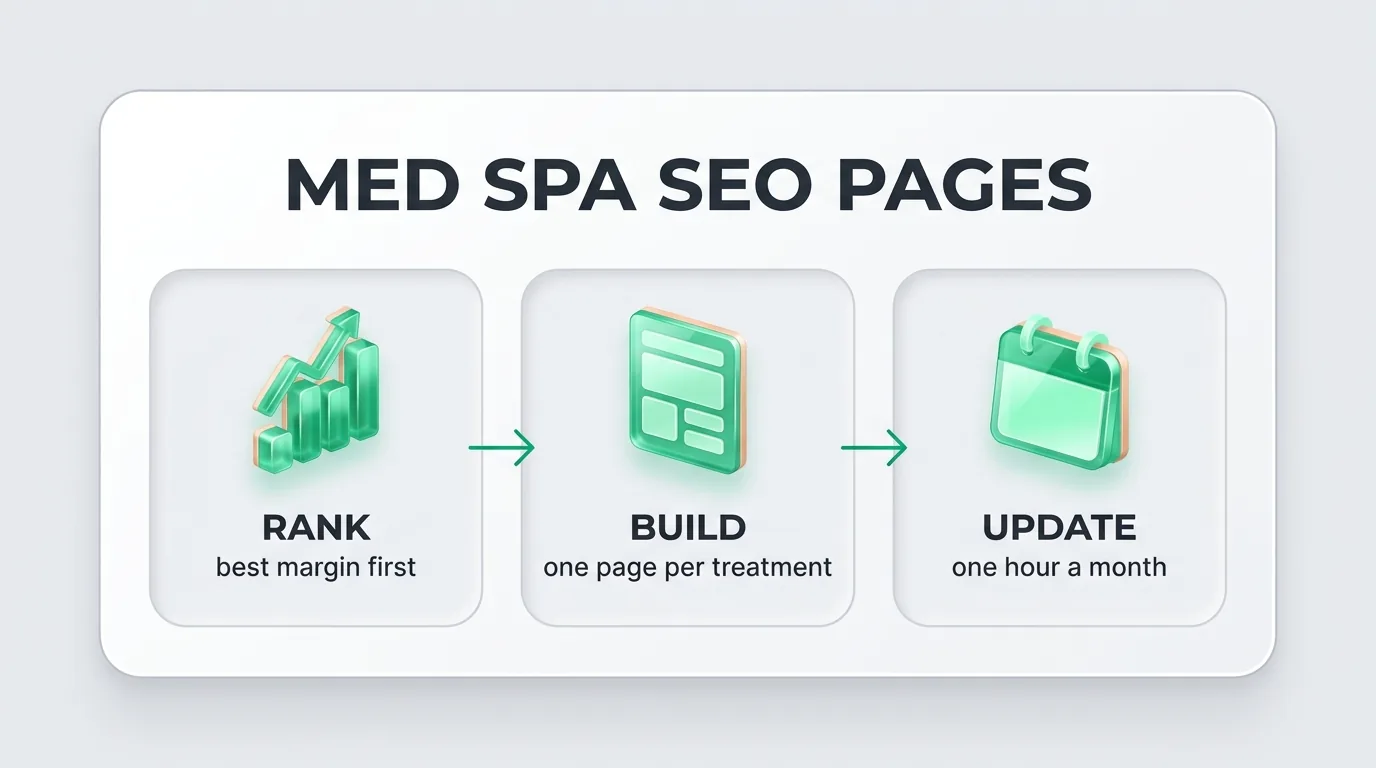
Most treatment menus hide the same imbalance: a few lines pay for the room, and the rest keep the room busy. SEO for a medical spa works when you build pages for the first group and stop there. Sort every treatment by contribution per hour of provider time rather than by ticket price. A course of laser resurfacing outearns a long run of walk-in facials, even when the facials look busier on Instagram. That order becomes your page order, and it is the first thing we rank when a practice hands the build to our medical spa SEO services.
A patient calls in February about the body contouring page they just read. Your one certified provider for that device left in November. The page still ranks, the phone still rings, and the front desk improvises.
Before you commit to a page, check the calendar: who performs the treatment, how many weeks a year they are on site, and who covers holidays or leave. If one provider carries a line alone, hold the page until a second one trains on it. Ranking for a treatment you cannot deliver costs you the booking, and it costs you the caller's confidence.
A patient scanning your menu wants to know you offer the treatment, then wants to know who performs it well. Secondary lines answer the first question fine on a single service list, one line each, with no page of their own. Twenty thin pages compete with each other and split the rankings you actually need. Keep a short set of full treatment pages at the top, each one deliberate. When a secondary line grows into steady demand, promote it then, which is usually the point where injectable treatment pages deserve a build of their own.
Three decisions carry a treatment page: which treatment it covers, who the treatment suits, and what the reader does next. Combine microneedling and chemical peels on one page and you ask Google to guess while the patient self-diagnoses. Split them. Each page needs its own title, a plain account of candidacy and expected results, and one next step repeated where the reading stops: a booking link that works, not a form in the footer. That discipline moves SEO for a medical spa further than any keyword list. If pages already sit on your site, auditing an existing site shows what to merge, rewrite, or retire first.
The one thing a competitor cannot copy from your page is the person holding the needle. Name them. Full name, license, years performing that specific treatment, training on that specific device, and a photo that looks like them on a Tuesday.
Patients weighing filler read provider credentials more carefully than they read your treatment copy, because the risk they are pricing is clinical. Search engines read the same page for a related reason: medical content needs a named, qualified author behind it. Where your team already draws its own patients, visibility for the providers on your team compounds what each treatment page earns.
When I still ran a clinic, the first real question in a consult was almost never about technique. They wanted to know how long the redness would last, and whether Monday at work was realistic. Put that on the page: downtime in days, what aftercare involves, and a cost range honest enough to filter. A patient who arrives already knowing the range arrives ready to decide, and your consult stops opening on price. Vague pages fill the schedule with people who leave at the quote.
A patient arrives in 2026 quoting a protocol you retired last spring. They read it on your own page. New devices, new consumables, revised session counts: each change orphans a paragraph somewhere, and the page keeps ranking while it misinforms. Tie the edit to the clinical change instead of a content calendar. Buy a device or revise a protocol, and the page update belongs in the same week. The same drift hits local visibility for a medical spa, where hours, listed services and photos quietly fall out of date.
An hour a month, named in one person's calendar, keeps your treatment pages accurate. Unowned, that hour waits for a quiet quarter that never arrives. Give it to whoever hears about clinical changes first, usually your lead provider or practice manager, and put the logins in their hands.
If nobody on payroll can hold the hour, choosing an SEO partner for the practice beats watching good pages decay. Keep the clinical judgment in house and hand over the rest.
Then compare scope and package options on one question: who edits the page when the protocol changes.
Pick the treatments you can staff and prove, build those pages properly, and keep one person accountable for their accuracy.
We review your pages, search visibility and enquiry path, then show you what to fix first.
.svg)